
The Stone That Needed a Seer
Queen Elizabeth's mathematician John Dee kept a crystal and a black mirror for speaking with angels, but saw nothing in them himself; every vision came through Edward Kelley.

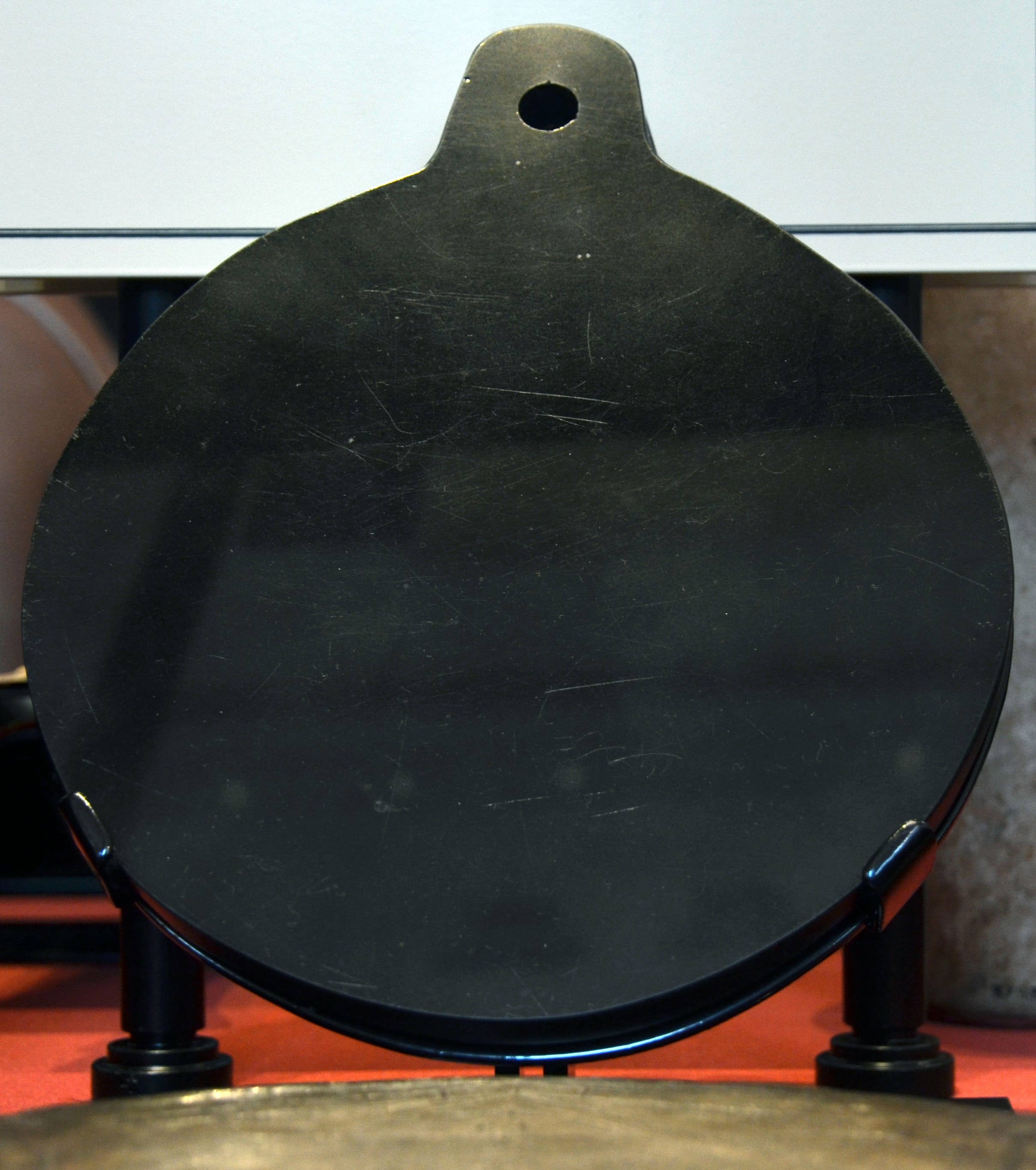
In the British Museum in London there is a case of objects that belonged to John Dee, a mathematician of the reign of Elizabeth the First. There is a mirror of polished obsidian, a black volcanic glass; it was made in Mexico, and came to Europe after the Spanish conquest. There is a ball of rock crystal on a stand. There is a disc of engraved gold, and there are discs of pale wax stamped with stars, crosses, and lettering. What these objects were used for is recorded in one of the most detailed documents of the English seventeenth century, a folio, the largest book format of the period, printed at London in 1659, from a manuscript in Dee’s own hand.
John Dee was born in London in 1527, the son of a gentleman servant at the court of Henry the Eighth. He studied at Cambridge, taught and lectured on mathematics, and became one of the learned men of his age. He was consulted on the choice of a day for Elizabeth’s coronation. He instructed the pilots of the English voyages that searched for a northeast passage to Asia. When the first English translation of Euclid, the Greek geometer whose textbook was the standard in the schools for two thousand years, was printed in 1570, it carried a long preface by Dee on the mathematical arts. At his house at Mortlake, on the Thames west of London, he assembled one of the largest libraries in England, several thousand printed books and manuscripts, and scholars and courtiers came there to use it.
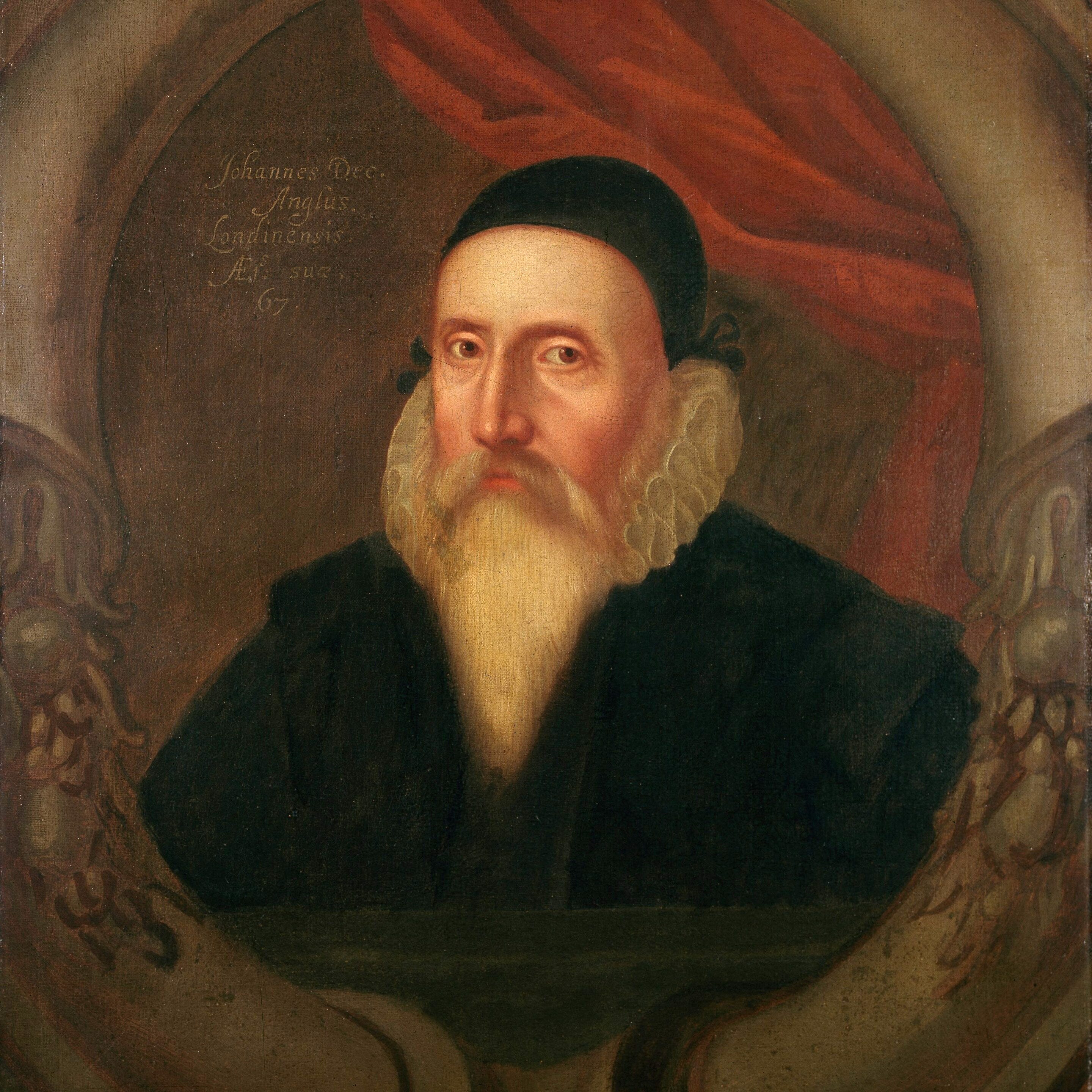
The books did not give him what he wanted. By his own account he had gone from degree to degree after the best knowledge a man could reach, and had found that “neither any man living, nor any Book I could yet meet withal, was able to teach me those truths I desired, and longed for: And therefore I concluded with my self, to make intercession and prayer to the giver of wisdom and all good things, to send me such wisdom, as I might know the natures of his creatures; and also enjoy means to use them to his honour and glory.” In his fifties he turned to an old method for obtaining it directly: scrying, the practice in which a man gazes into a polished stone or glass until figures appear to him there and speak. Dee gazed, but the visions did not come to him as they came to a practiced skryer, so the seeing had to be done by another man.
Source: Dee’s record of his audience with the Emperor Rudolf the Second, Prague, the morning of 3 September 1584, as printed in A True and Faithful Relation, 1659.
The seer
At first he employed one named Barnabas Saul; in March of 1582 Saul confessed that he could no longer hear or see any spirit, and left his service. Within days another man came to Mortlake, in his twenties, giving his name as Talbot. He looked into Dee’s stone and reported an angel in it, though his name was in fact Edward Kelley. Dee took him into his household at a stipend of fifty pounds a year, and for the next seven years the two men worked as parts of one instrument: Kelley looked into the stone and spoke what he saw and heard; Dee sat at the table, put the questions, and wrote everything down.
Source: the skryer before Kelley, and Kelley’s arrival under the name Talbot, are recorded in Dee’s own private diary, kept in the margins of his almanacs and printed from the manuscript in 1842.

What Kelley saw in the stone were figures Dee took to be angels. One came in the shape of a young girl who called herself Madimi. Dee questioned them for the knowledge he had not found in his books: the nature of things, the will of God, and the course he should take in his own affairs. He believed he was setting down the words of God’s messengers.
Dee called the sittings actions, and kept their minutes himself for a quarter of a century, in a record that names the day, the place, the questions, and the answers. In it he writes himself as the Greek letter delta, Δ. Meric Casaubon, who printed the record in 1659, described how the two divided the work: “It is true indeed, that ordinarily, Dr. Dee saw not himself; his business was to write what was seen (but in his presence though) and heard by Kelley.”
Source: Meric Casaubon’s preface to A True and Faithful Relation of What passed for many Yeers between Dr. John Dee and some spirits, London, 1659.
Outsiders began to attend. In 1583 a Polish nobleman, Albert Laski, came to England and sat in on some of the sittings, and through Kelley the spirits singled him out. They named him a chosen instrument of a coming reformation of kingdoms and promised that he would be made a king; Casaubon later summed up their aim through him as “to turn all things upsidedown in the World.” On that promise Dee broke up his house at Mortlake.
When Laski sailed home late in 1583 he took both households with him: Dee and Kelley, their wives, and their children. They traveled through Poland to Prague, where Dee was received by Rudolf the Second, the Holy Roman Emperor; the later years they spent at Trebona in Bohemia. The actions continued through all of it. While Dee was abroad, his library at Mortlake was broken into and plundered.
Source: the spirits’ designation of Laski and the promise of a crown are in the action records printed in A True and Faithful Relation, 1659; the quoted phrase is from Casaubon’s summary of the contents.
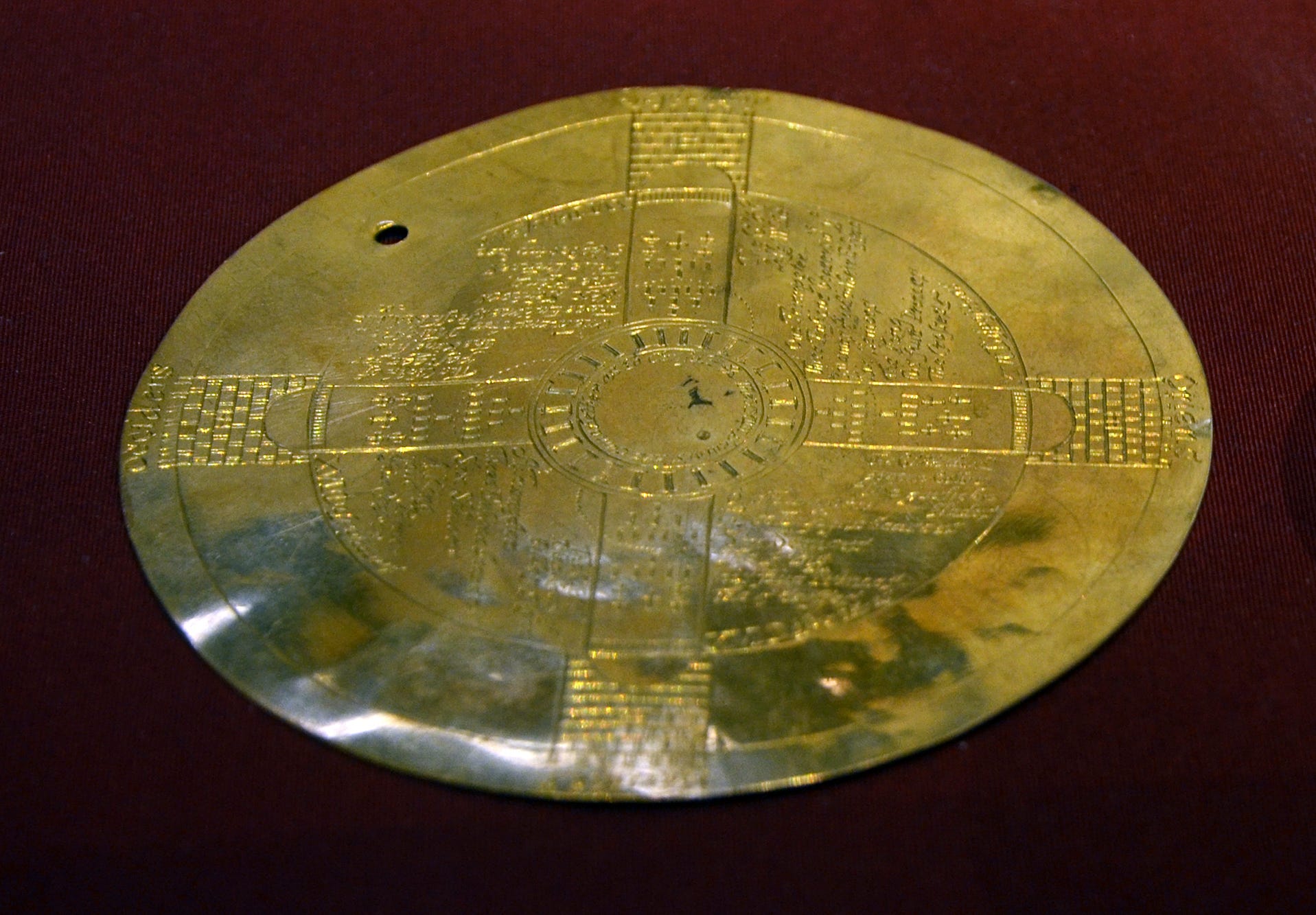
The company passed the spring and summer of 1584 at Kraków on the way to Prague, and one morning there in June, as Kelley lay awake in bed, he saw “four very fair Castles, standing in the four parts of the world”. That afternoon one of the spirits expounded the vision as a picture of how the earth is governed. The four castles were four angels standing watch over the four quarters of the world, “the 4 Overseers, and Watch-towers” of the record, and the banners carried out of their gates bore the names of God that govern the creatures of the earth. To know the names, the spirit said, was to command what they governed: “Hereby may you subvert whole Countries without Armies: which you must, and shall do, for the glory of God.” The disc is that vision engraved in gold, a chart of the powers said to govern the earth and of the names by which a man could address them.
Source: Dee’s record of the vision of 20 June 1584 at Kraków and its exposition the same afternoon, as printed in A True and Faithful Relation, 1659.
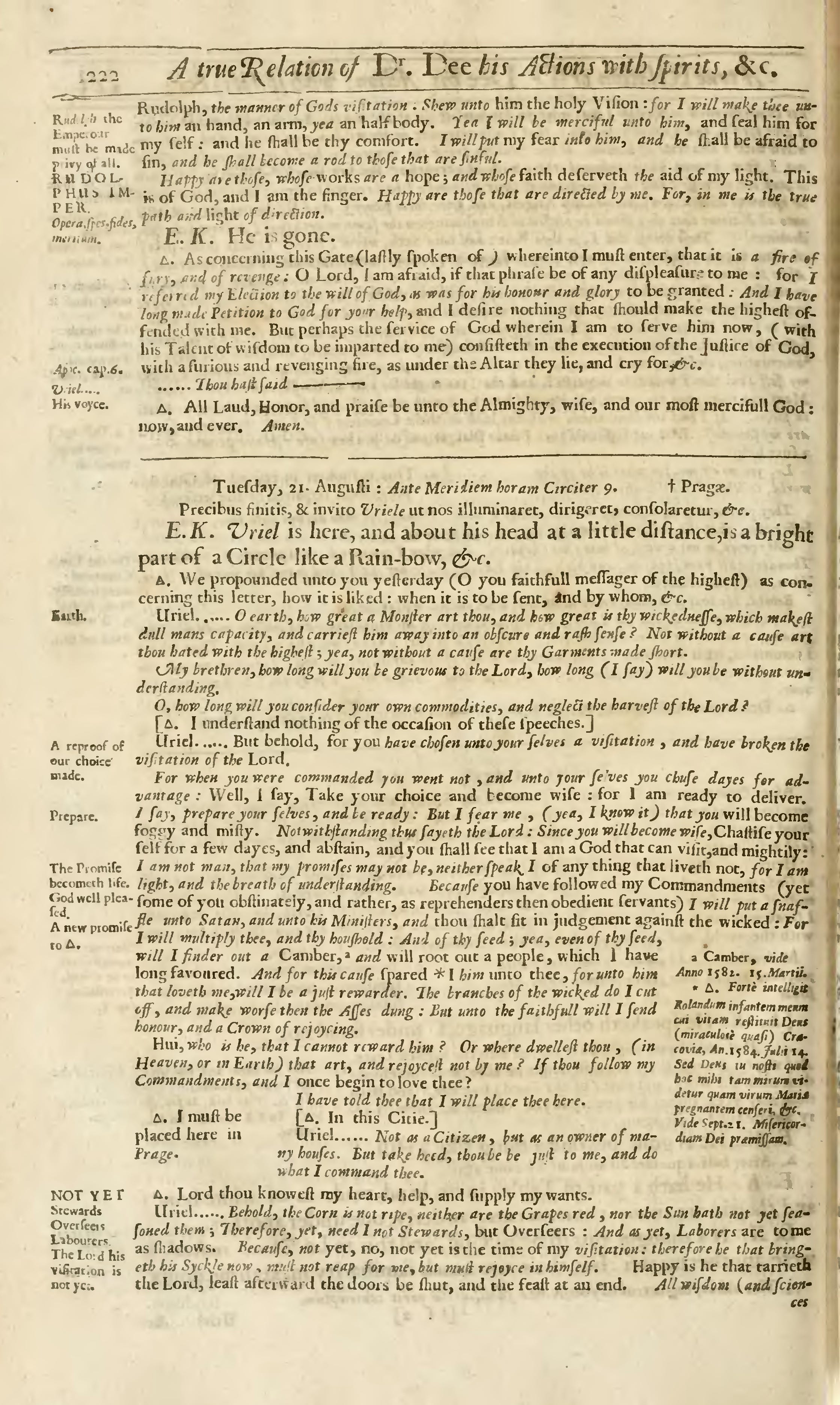
That September Dee carried what the stone had told him to the emperor himself. Received in the castle at Prague, he wrote out his own words afterward: “The Angel of the Lord hath appeared to me”, he told Rudolf, and if the emperor would “hear me, and believe me, you shall Triumph: If you will not hear me, The Lord, the God that made Heaven and Earth, (under whom you breath, and have your spirit) putteth his foot against your breast, and will throw you headlong down from your seat”. The emperor heard the message out, gave no answer of his own, and referred Dee to one of his counselors. There was no second audience, and nothing the angels had promised came of it.
Source: Dee’s own account of his audience of September 1584, as printed in A True and Faithful Relation, 1659.
The language of Adam
Across months of sittings the spirits also dictated whole books through tables of letters. A squared table of letters would appear in the stone, the spirit pointing from place to place, Kelley naming each letter and its position, and Dee, who had matching tables drawn on paper before him, writing each letter down.
What came through the tables were alphabets, texts in a language that was not any known tongue, and a set of invocations the record names the calls. The spirits gave an account of what that language was. It was the speech Adam had spoken before the fall. Adam is the first man of the book of Genesis, and the fall is his disobedience in the garden and his expulsion from it. In the garden he had been brought every living creature and had given each one its name, and those names, the spirit said, stated what each creature was: he “spoke of them properly, naming them as they were”. Since the fall the speech had been lost, “never uttered nor disclosed to man since till now”. Its words were said to act on the creatures they named: “so are the creatures of God stirred up in themselves, when they hear the words wherewithal they were nursed and brought forth”. The books had given him what men reported about the creatures. The stone was giving him the creatures’ own names.
The calls came with a rule of handling. Dictating them at Kraków in the spring of 1584, the spirit Nalvage said the words were to be given in one direction and used in the other: “Also in receiving of the calls, this is to be noted: that they are to be uttered of me, backward: and of you, in practise, forward.” The letters that followed were dictated in reverse order. Dee set down the reason as he understood it: “I understand it, for the efficacity of them; else, all things called would appear: and so hinder our proceeding in learning.” Read out in their proper order the words would take effect, which is why the dictation ran backward. Written in reverse they were without effect, and the lessons could go on. None of it was printed in Dee’s lifetime.
Source: the action records printed in A True and Faithful Relation, 1659; the account of the language is from the action of 21 April 1584 at Kraków, and the rule for receiving the calls from the action of 12 April 1584 at the same place.
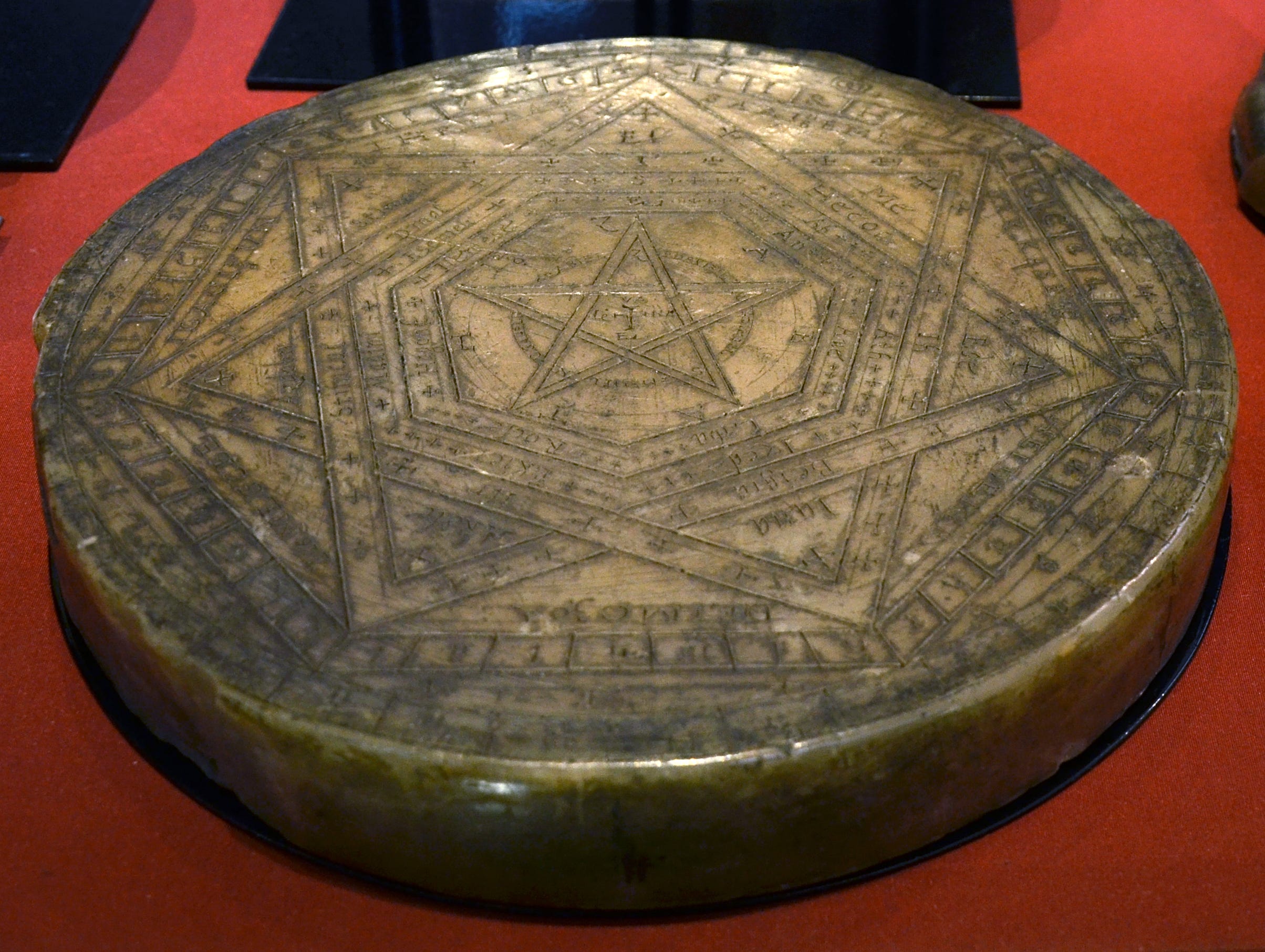
The stone did not sit on the bare table. It rested on a disc of purified wax nine inches across, the Sigillum Dei Aemeth, the seal of God’s truth, the last word being the Hebrew for what is true and trustworthy. The pattern stamped on its face was dictated in the spring of 1582, in Kelley’s first weeks at the stone. Names of God were engraved on it, and angels’ names derived from those by rule. The seal lay at the centre of a table made to instructions given at the same sittings, and four smaller seals of the same pattern stood under the table’s four legs. Dee used the seal as a register of who might speak. In an action of June 1583 a spirit at first refused its name, then said, “I am almost HATH”. Dee answered, “I understand you to be ATH, in sigillo Emeth”, in the seal of truth. He had found the name on the seal beneath the stone.
Source: the seal’s pattern and dimensions, from the manuscript instructions of 1582, are described in Charlotte Fell Smith, John Dee, 1909; the exchange with the spirit ATH is in the action records printed in A True and Faithful Relation, 1659.
The instrument had one part that could not be replaced, and it was not the stone. The 1659 preface, answering readers who might doubt that Dee’s record meant what it said, points out that the seer’s place was an office, and that it was filled by more than one man: “not Kelley only served in this place of Seer or Skryer, but others also, as his son Arthur, and in his latter dayes, when Kelley was either gone or sick, one Bartholomew”. The owner of the stone is not in the list. In twenty-five years of actions the seer changed more than once, but Dee’s part did not. He asked the questions and wrote down the answers. An instrument that works only through one prepared man was what the magical books of the age required. Dee’s apparatus met that condition, and the prepared man was not its owner.
Source: Casaubon’s preface, 1659.
Dee recorded that dependence himself. In his private diary, on the days a vision came clear, he set down his thanks; and once, when the angel Michael was rightly named in the stone, he wrote: “Laus sit Deo et doctori meo E. K.”, praise be to God, and to my teacher, E. K. Doctor in his Latin means the learned one, the master. Elsewhere he recorded that he had seen the divine water only by Kelley’s showing. The man who had prefaced Euclid and filled Mortlake with several thousand books, keeping his own accounts with no one watching, called his young skryer his master.
Source: Dee’s private diary, entries of 1 May 1587 and 24 August 1588; the Latin as printed in the 1842 edition.
Trying the spirits
Even if the figures in the stone were spirits, a question remained. A spirit gave a name; it said it was Uriel, an angel of God. Nothing outside its own word confirmed this. The seal was not an outside check, because its register of names had itself been dictated through the stone. Kelley could not step behind the vision to check it, and Dee could not see the vision at all. Whatever came was received on the sender’s own account of itself.
The age had a discipline for this. The testing of spirits was old, set down in scripture the two men knew by heart: “try the spirits whether they are of God,” against the standing warning that “Satan himself is transformed into an angel of light.” Because a spirit’s claim about itself proved nothing, it was tried by whether it confessed Christ and by the fruits of what it commanded. The work of telling a true messenger from one that lies about who it is had a name, the discernment of spirits.
Source: 1 John 4:1 and 2 Corinthians 11:14, King James Version. James ordered the translation at Hampton Court in 1604, the year of Dee’s petition to him.
The three men closest to the record judged the sender differently. Kelley, who alone could see, maintained for most of the seven years that the apparitions were nothing but “meer illusions of the Divel and evil Spirits,” and he made Dee enter that doubt in the book; Dee swore to him on his own soul that they were “good Spirits sent from God.” Casaubon, printing the record in 1659, judged that Kelley had been right.
Casaubon also set out an obvious possibility, as the first objection he meant to answer: that there was no true sender to identify at all, and that Kelley had invented what he reported while Dee believed him. “Although ‘tis very probable that Dr. Dee himself dealt simply and sincerely; yet since he himself saw nothing (for so himself acknowledgeth in some places) but by Kelley’s eyes, and heard nothing but with his ears. Is it not possible that Kelley being a cunning man, and well practised in these things might impose upon the credulity of Dr. Dee (a good innocent man) and the rather, because by this office under the Doctor he got 50 l. by the year, as appeareth.” “Truly this is plausible as it is proposed”, he wrote, and argued against it from the length of the record and the other seers. Nothing in the record decides among the three.
The record shows how far Dee’s trust could reach. In the spring of 1587, at the castle of Trebona in Bohemia, Kelley reported that the spirit Madimi, the one who had first appeared as a girl, commanded the two men to hold all things in common, their wives included; a covenant to that effect was written out and signed by both men and both wives, and Dee, who set down his own revulsion, obeyed it. By the tradition’s own test this was the fruit by which a lying spirit was to be known, a command no messenger of God would give; Dee kept faith with the sender anyway. Since every word of the seven years passed through Kelley, the man who paid for the words could not check them. Two hundred and ninety years later the same undecidable question would be asked of a motor in Philadelphia that ran only for its inventor.
Source: Casaubon’s preface, 1659 (the objection and the fifty pounds); the command through Madimi and the covenant of common life are in the action records printed in A True and Faithful Relation, 1659, and in Dee’s private diary, entries of 1587. The l. in 50 l. is the old abbreviation for pounds.
The name of conjurer
The two men parted in 1589, after the fellowship had soured into quarrels and mistrust. Dee returned to England; Kelley stayed in Bohemia, where the emperor made him a baron for his alchemy, then twice imprisoned him when the gold did not come, and he is said to have died about 1597 of injuries from a fall in an attempted escape.
The name of conjurer had followed Dee for half his life, and in his last years it turned dangerous. The new king, James, was a student of the subject. Seven years before he came to the English throne he had published the Daemonologie, a dialogue arguing that witchcraft and the trafficking with spirits were real, and damnable, and to be punished; and once in England he pressed a harsher witchcraft law through Parliament. In it James wrote that the learned are drawn to the black arts by their own appetite for knowledge, “mounting from degree to degree, vpon the slipperie and vncertaine scale of curiositie; they are at last entised, that where lawfull artes or sciences failes, to satisfie their restles mindes, even to seeke to that black and vnlawfull science of Magie.” Dee had written that his own books failed to satisfy him, and had turned to the stone.
On the 5th of June 1604, at Greenwich, the old man handed this king a petition. He did not ask for protection. He asked to be put on trial, because a trial and an acquittal were the one thing that could clear the name in law, and he offered to die if the charge could be proved: “Therefore he offereth himself willingly to the punishment of Death, yea eyther to be stoned to death, or to be buried quicke [alive], or to be burned unmercifully, if by any due, true, and just meanes, the name of conjurer, or caller, or invocator of Divels or damned Spirites, can be proved to have beene or to be duely or justly reported of him.” No trial was ever granted. He died at Mortlake in 1609, in his eighty-second year, poor, having sold his books to live.
Source: James VI and I, Daemonologie (Edinburgh, 1597), First Book, in the original spelling; and Dee’s petition to King James, 5 June 1604, as printed in Charlotte Fell Smith, John Dee, 1909. The petition speaks of Dee in the third person, as such documents did; buried quicke means buried alive.
The manuscript minutes passed after Dee’s death into the library of the collector Sir Robert Cotton, and in 1659 Casaubon printed them in full. He printed them not to defend the undertaking but to condemn it, and by printing it he preserved it, as the hostile commissioners of 1784 preserved the record of the tub they had come to test.
Source: Casaubon’s preface, 1659.
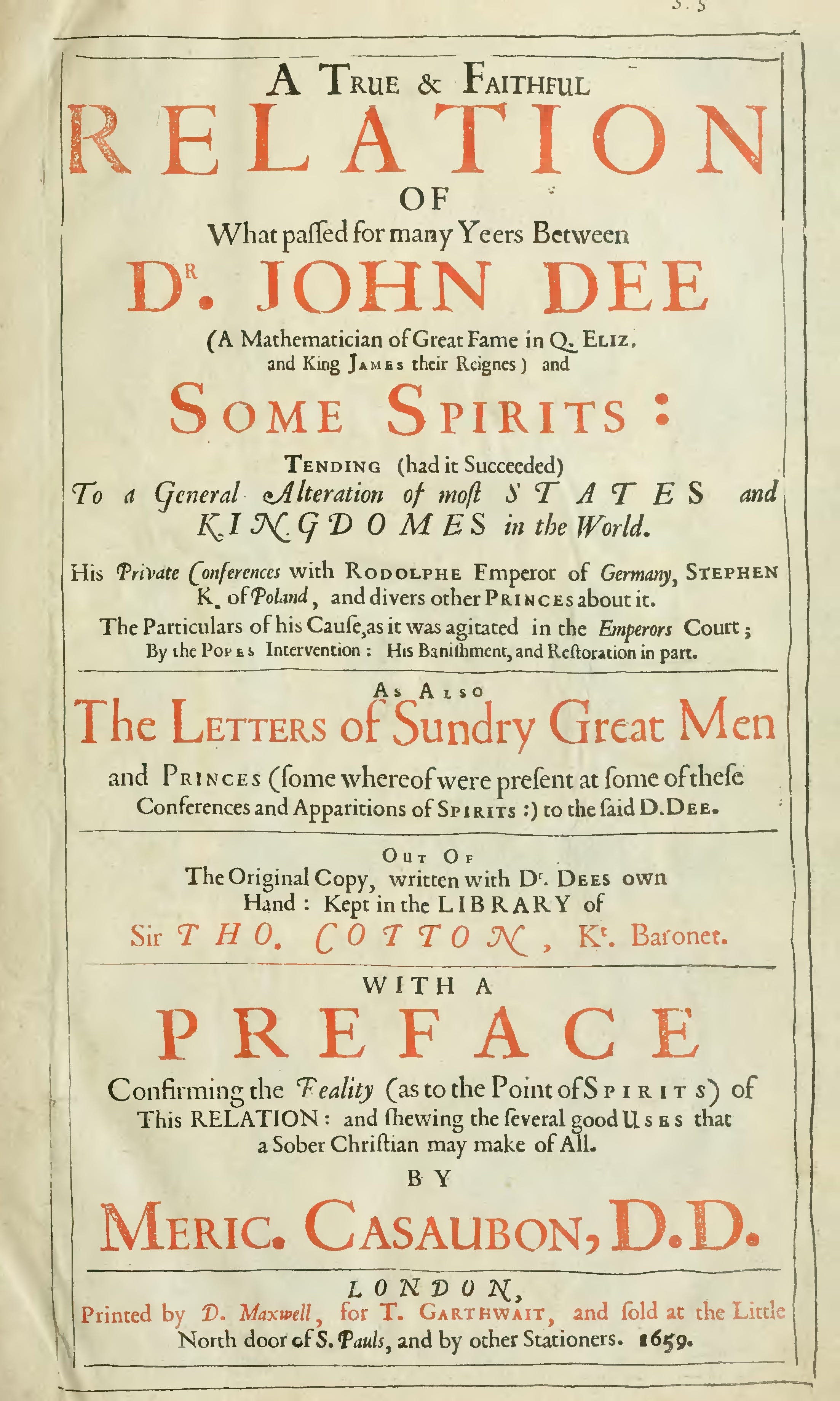
Everything the actions needed is in that museum case now, except the one thing the record shows they could not do without. The mirror is there, and the crystal, the gold disc, and the wax seals. The seer is not in the case. Dee owned the stone, framed the questions, and kept the minutes. Kelley saw; Dee never could. When Kelley was gone or sick the sittings waited for another seer; the seers could be engaged, doubted, and replaced, and the owner’s place never changed. But the instrument could not run without a seer, and the seer was its only witness. The single channel that made the instrument run made its messages impossible to check. The mirror is in its case, and anyone may look into it. Who was speaking through it, and whether anyone was, could no longer be asked once the last man who could see in it had died.
---
Part 5 of “The Occult History of Technology.” Previously: Ghosts in the Machine.