
The First Blinded Experiment
In 1784 a royal commission under Benjamin Franklin tested Mesmer's animal magnetism and invented the placebo control to test an occult claim.

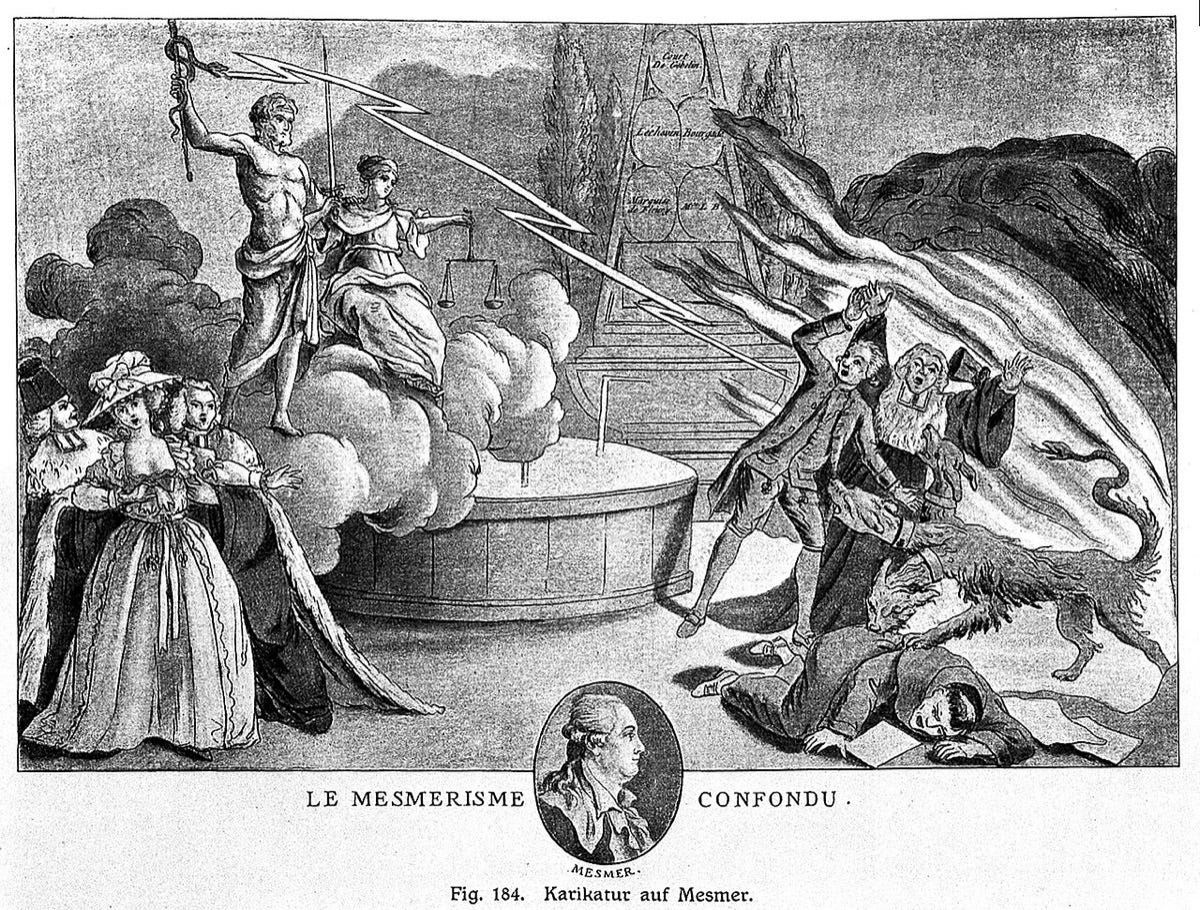
In 1778 a German physician named Franz Anton Mesmer arrived in Paris with a new medicine. He taught that a physical influence, a subtle fluid he called animal magnetism, flowed through the human body, that a practitioner could direct it into a patient, and that directing it cured disease. In the memoir on his discovery that he published in 1779, he wrote that the action of this fluid was “subject to mechanical laws, hitherto unknown.” Within a few years the treatment was the fashion of the city. His name is the origin of the English word mesmerize. Mesmer’s house in Paris was crowded with patients, and the operation was performed publicly every day. An account of the affair printed in London in 1785 says that animal magnetism “became a mode, an affair of bon ton, an interest, extremely precious and warmly espoused by the fashionable world.” Charles Deslon, a Paris physician who was for many years Mesmer’s pupil and became the best-known practitioner of the method after Mesmer himself, “is said to have cleared £100,000.” The same account reports that the new system “seems to have divided the public speculations with the celebrated and incomparable discovery of the aerostatic globe”: the hot-air balloon of the Montgolfier brothers, which had carried the first men into the air over Paris in 1783.
Source: the historical introduction to the English translation of the commissioners’ report, London, 1785.
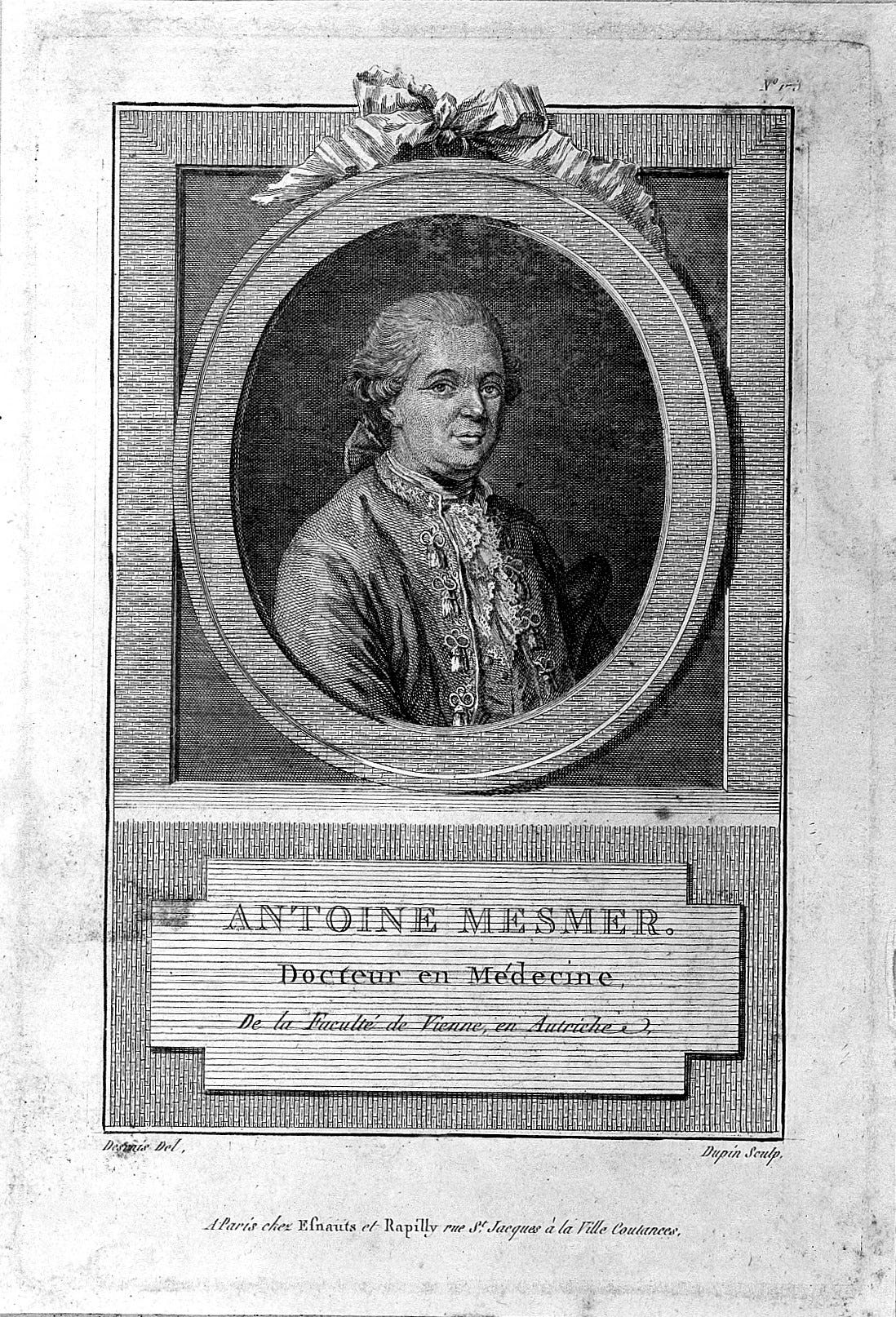
In the treatment room was the baquet, a covered tub of iron filings and magnetized water. Jointed iron rods ran from its lid to the afflicted parts of the patients, a cord was passed around their bodies, and each held a neighbor’s thumb, so that the magnetic impression, the practitioners taught, passed through the whole circle. The commissioners who later investigated recorded the scene: “A piano forté is placed in one corner of the apartment, and different airs are played with various degrees of rapidity; vocal music is sometimes added to the instrumental.” The music itself, the practitioners explained, conducted the fluid to the patients. And the treatment produced what the practice called crises: “These convulsions are rendered extraordinary by their frequency, their violence and their duration. As soon as one person is convulsed, others presently are affected by that symptom. The commissioners saw accesses of this kind, which lasted upwards of three hours.”
The report records the crises in a physician’s detail, the convulsed limbs and contracted throats, the “shrieks, tears, hiccuppings, and immoderate laughter.” It records that the music was part of the machinery: “the changing of the key and the time, in the airs played upon the piano forté, had an effect upon the patients; so that a quicker motion agitates them more, and renews the vivacity of their convulsions.” It records that the premises included “an apartment lined with quilting,” built for the convulsed and “denominated the apartment of crises.” And it records the commissioners’ own astonishment: “Nothing can be more astonishing than the sight of these convulsions; he that has not had it, can have no idea of it.”
The report also states, as an observed fact, where the control lay. The patients “are entirely under the government of the person who distributes the magnetic virtue: in vain they may appear to be in a state of the extremest drowsiness, his voice, a look, a sign from him rouses them.” And the commissioners described what they were watching: “It is impossible not to recognise in these regular effects an extraordinary influence, acting upon the patients, making itself master of them, and of which he who superintends the process, appears to be the depository.” The question the commission existed to answer was what this mysterious influence was.
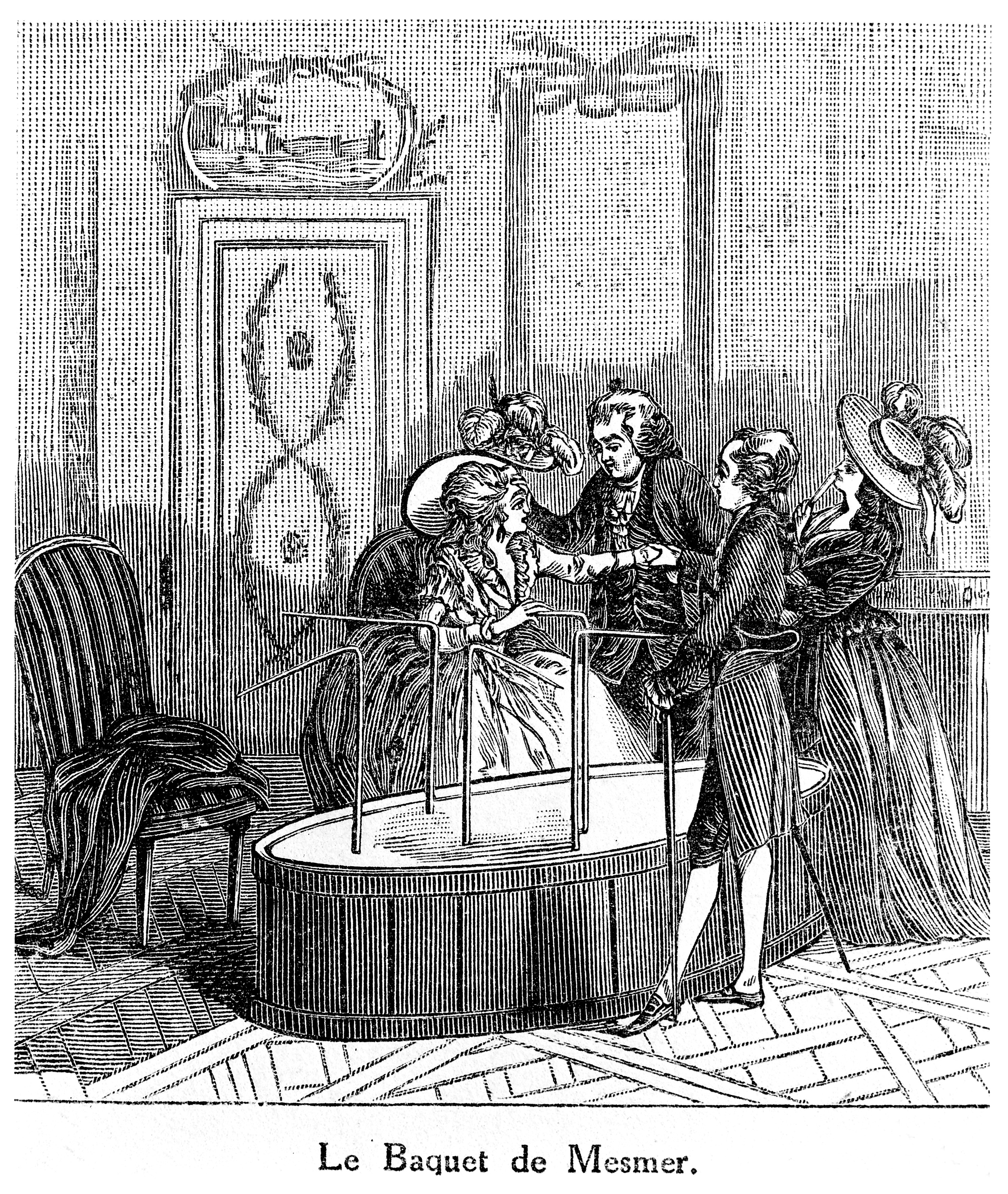
This was what educated Paris was arguing about in the spring of 1784: rooms of the well-born in convulsions around a tub of magnetized water, cures reported daily, and an inventor who insisted the agent at work was physical, a real fluid and not the patient’s imagination. Mesmer described the animal magnetism as “a fluid universally diffused; the vehicle of a mutual influence between the celestial bodies, the earth and the bodies of animated beings,” and its effects as produced by the fluid “insinuating itself into the substance of the nerves.” He described a fully physical agent. In his account, the human body had “poles different and opposite,” like a naturally magnetic loadstone. The body had a pole at each end and its magnetism ran between them in a definite direction, so that by the practice’s rules it took effect when applied one way and did nothing when applied the other. Its virtue could also be “reflected by mirrors,” “propagated and augmented by sound,” and “accumulated, concentrated and transferred.”
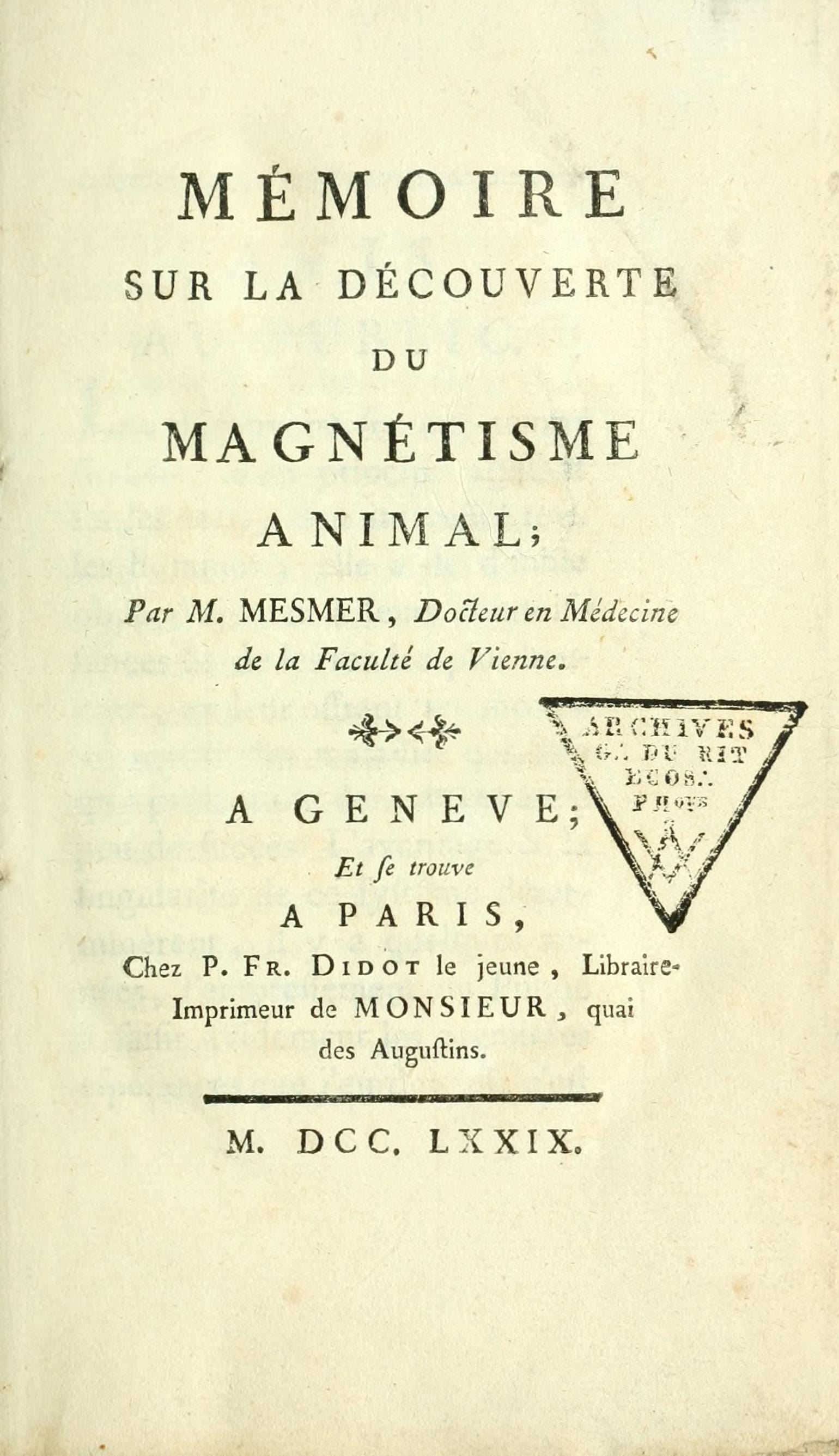
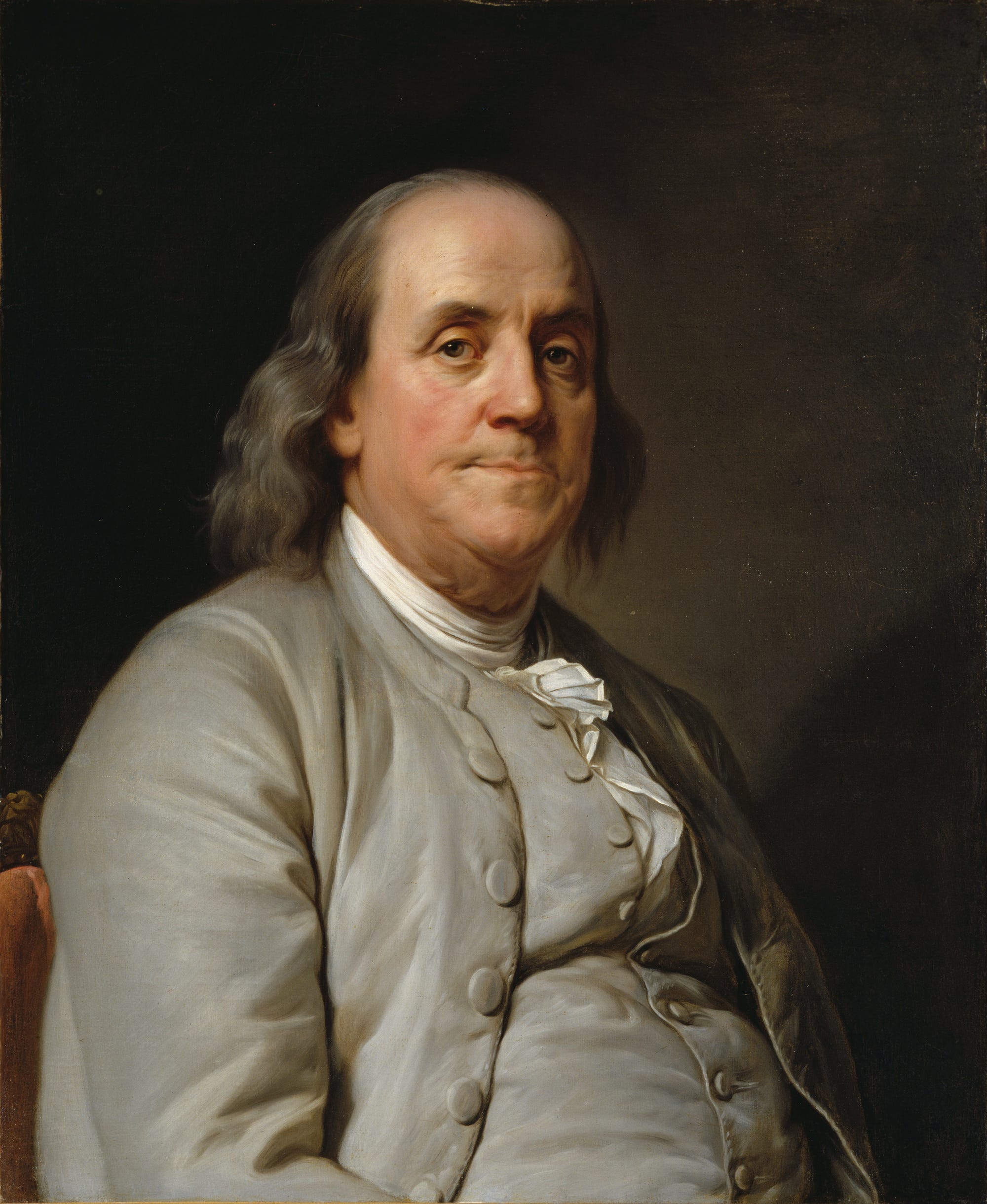
In March 1784 Louis XVI appointed the Royal Commission on Animal Magnetism to determine whether that fluid existed: four physicians of the Paris faculty, Borie, Sallin, d’Arcet, and Guillotin, and, at the physicians’ own petition, five members of the royal academy of sciences, Franklin, le Roy, Bailly, de Borie, and Lavoisier. Benjamin Franklin, then the American minister at Paris, presided. During the Revolution that followed, Bailly and Lavoisier died on the guillotine, the machine that took its name from their fellow commissioner Guillotin. Mesmer refused to deal with the commission, and it was Deslon who consented to disclose the principles and assist the inquiry, so the practice the commissioners examined was his. Their design separated the physical treatment from the patient’s knowledge of it, and crossed the two: magnetism applied without the patient’s knowledge, and sham magnetism applied in full view.
The commissioners ran the design in both directions, on subjects supplied by the practice itself. The report records the trial of one sensitive subject: “She was accordingly blindfolded and magnetised; the phenomena no longer answered to the places towards which the magnetism was directed.” In the orchard of Franklin’s garden at Passy the commissioners tried the same separation on a single tree. Deslon claimed that a tree he had magnetized would throw a susceptible person into crisis, so one apricot tree, set well apart from the others, was magnetized, and Deslon brought a twelve-year-old boy he had chosen himself as reliably susceptible. The boy was blindfolded and led to embrace four trees in turn, and the magnetized tree was not among them; Deslon, kept at a distance with commissioners between him and the boy, aimed his cane at the real tree from where he stood. At the first tree the boy sweated and reported a slight pain in his head; at the second and third the symptoms grew, and he said he thought he was nearing the magnetized tree; at the fourth, still a tree nothing had been done to, “the boy fell into a crisis; he fainted away, his limbs stiffened, and he was carried to a neighbouring grass-plot.” He had convulsed under a tree that carried no magnetism, and had never been brought near the one that did. The crisis had followed his belief about where the magnetism was, not the magnetism.
The design was also run with no treatment at all. At Franklin’s house the commissioners asked Deslon to bring patients of proven susceptibility, and two women were placed in separate rooms. One, dame P., was blindfolded and “persuaded that M. Deslon had been brought into the room to perform the magnetical operation.” Three commissioners sat with her and did nothing but watch. Within three minutes she shuddered, stiffened, struck her hands together, stamped her feet: “the crisis had all the regular symptoms.” The other, mademoiselle B., sat with her eyes uncovered, “seated with her face towards a door which was shut, and persuaded that M. Deslon was on the other side, employed in performing upon her the magnetical operation.” In the third minute she fell into a full crisis; “she bit her hand, and that with so much force, that the marks of the teeth remained perfectly visible.”
The strictest experiment combined the two: real treatment, and no knowledge of it. Two adjoining rooms were separated by a doorframe covered with a double thickness of paper, and mademoiselle B., the same woman who at Passy had fallen into a crisis within three minutes while nothing at all was done to her, was brought in on a pretext and seated against the partition. On the other side, a foot and a half away, a physician among the commissioners who had performed the magnetical operation with success on other occasions magnetized her through the paper for thirty minutes, following the rules the commissioners had watched at Deslon’s house; Deslon had declared beforehand that the magnetism passes through paper. She conversed with much gaiety the whole time and answered, when asked about her health, that she felt perfectly well. The same commissioner then came into her room and repeated the operation where she could see it. This second time he worked it against the practice’s own rules, magnetizing her in the direction of the poles, the direction in which, by those rules, no effect ought to have been produced. In three minutes she was in a complete convulsive crisis. The report drew the inference in her case: “The only reason of this difference must be that here she was ignorant of the operation, and that at Passy she thought it had been performed. The inevitable conclusion is, that the imagination singly produces all the effects attributed to the magnetism, and that, where the imagination ceases to be called forth, it has no longer the smallest efficacy.”
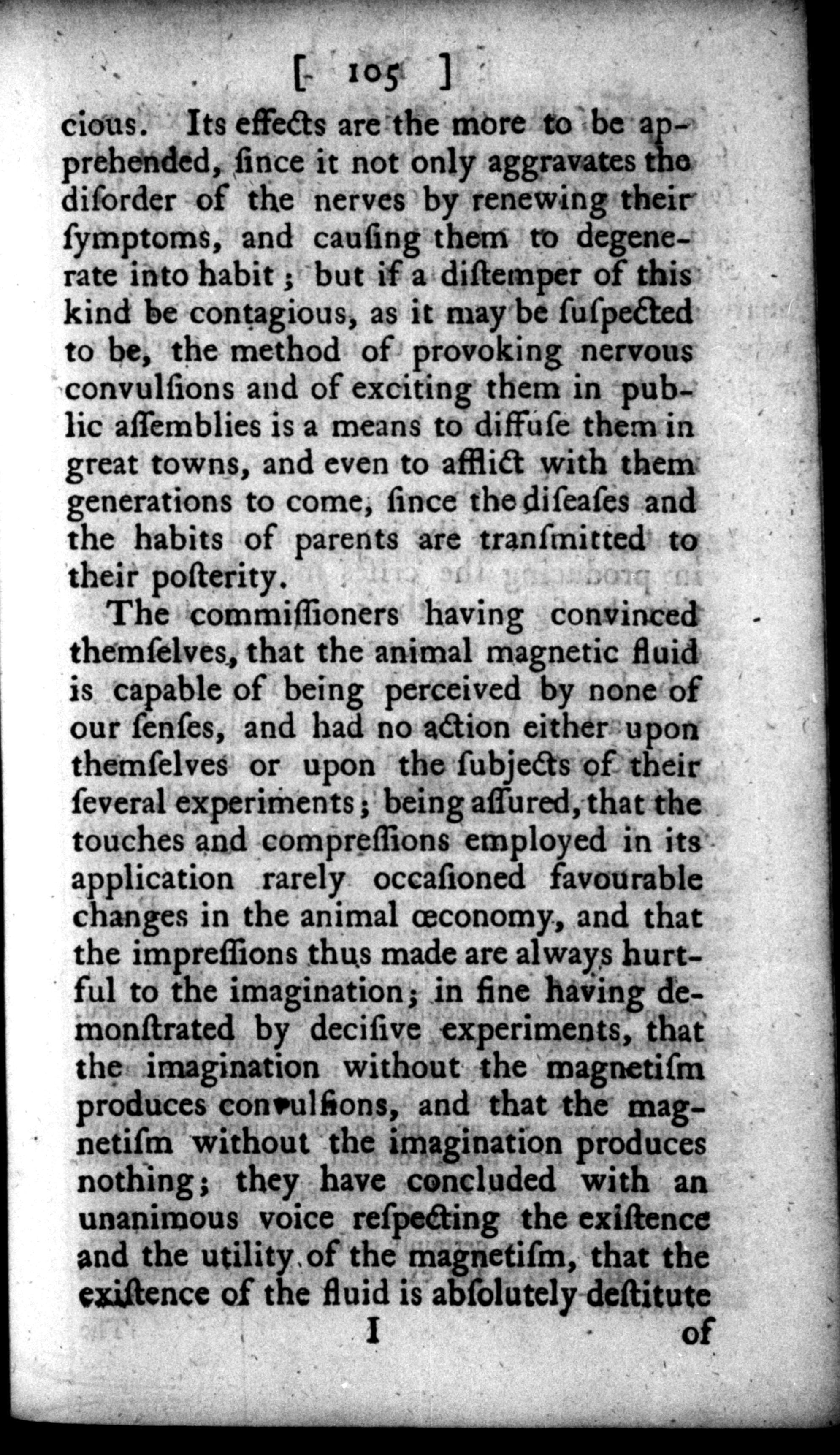
The conclusion the commissioners signed on August 11, 1784, generalized it: they have “demonstrated by decisive experiments, that the imagination without the magnetism produces convulsions, and that the magnetism without the imagination produces nothing.”
Source: Report of the commissioners, English translation, 1785.
The commissioners also submitted themselves to the treatment. A separate tub was set apart for their use at Deslon’s house, and they went there once a week; each sitting lasted two hours and a half, with the iron rod held to the body, the cord of communication around them, and the chain of fingers formed, the operation performed by Deslon himself or by one of his pupils. The result: “Not one of the commissioners felt any sensation, or at least none which ought to be ascribed to the action of the magnetism.” Everything physical in the treatment had been kept, and kept longer than in the public room. What had changed was the subjects and the setting: healthy men sitting quietly in private, instead of a crowded room of the sick. The report records the comparison between the two scenes: “All was calm and silence in the one, all restlessness and agitation in the other; there multiplied symptoms, violent crises, the ordinary state both of body and mind interrupted and overthrown, and nature wrought up to the highest pitch; here the body free from pain, and the mind from anxiety, nature preserving her ordinary course and her equilibrium.”
The effects followed what the patients believed, not what was done to their bodies. This is the founding experiment of the blinded controlled trial, the method that still governs the testing of medicine. When a drug is tested now, some patients receive the drug and some receive an inert substitute that looks the same, and neither the patients nor those testing them know which is which, so that whatever belief produces is measured on its own and subtracted. The placebo control was invented to test an occult claim.
Two explanations
The experiment is, in form, a removal experiment, but the operator was not what it removed. In the partition experiment the physician stood a foot and a half from the patient, working by the rules of the practice, for thirty minutes. What was removed was the patient’s knowledge that the operation was being performed. Treatment without knowledge produced nothing; belief without treatment produced the full crisis. If anything passed from operator to patient, it did not behave the way a physical emanation behaves, acting on its object whether or not the object is aware of it. The effect required the patient to know.
Two explanations of that fact are available, and the experiment cannot separate them.
The first: the effect lives in the patient’s imagination, and there is no fluid and no connection. The patient’s belief produces the convulsions, and the operator contributes nothing but an occasion for the belief. This is the commission’s own conclusion, and it is the account on which the testing methods of modern medicine were built.
The second: something real passes between operator and patient, and the patient’s awareness of the operator is part of the channel it passes through. On this account the connection is not a physical radiation but a relation between two people, and it exists only while the patient is party to it. Blinding severs exactly that awareness, so the experiment measures the severance. The trial removes the patient’s knowledge of the operator and the effect stops, which is what the magician’s rule predicts for an operation that must pass through human beings.
The experimental result is identical on both accounts. An experiment whose method is to sever the connection cannot decide whether it severed an illusion or a working relation.
The first account is simpler, requires no new entity, and every practical success since has been built on it: blinded trials work, and they work because imagination effects are real and measurable. The second account is not refuted by any of that. It predicts the same data. Nothing in the 1784 design, or in any later design built on it, distinguishes a force that does not exist from a force that requires the very connection the blind removes.
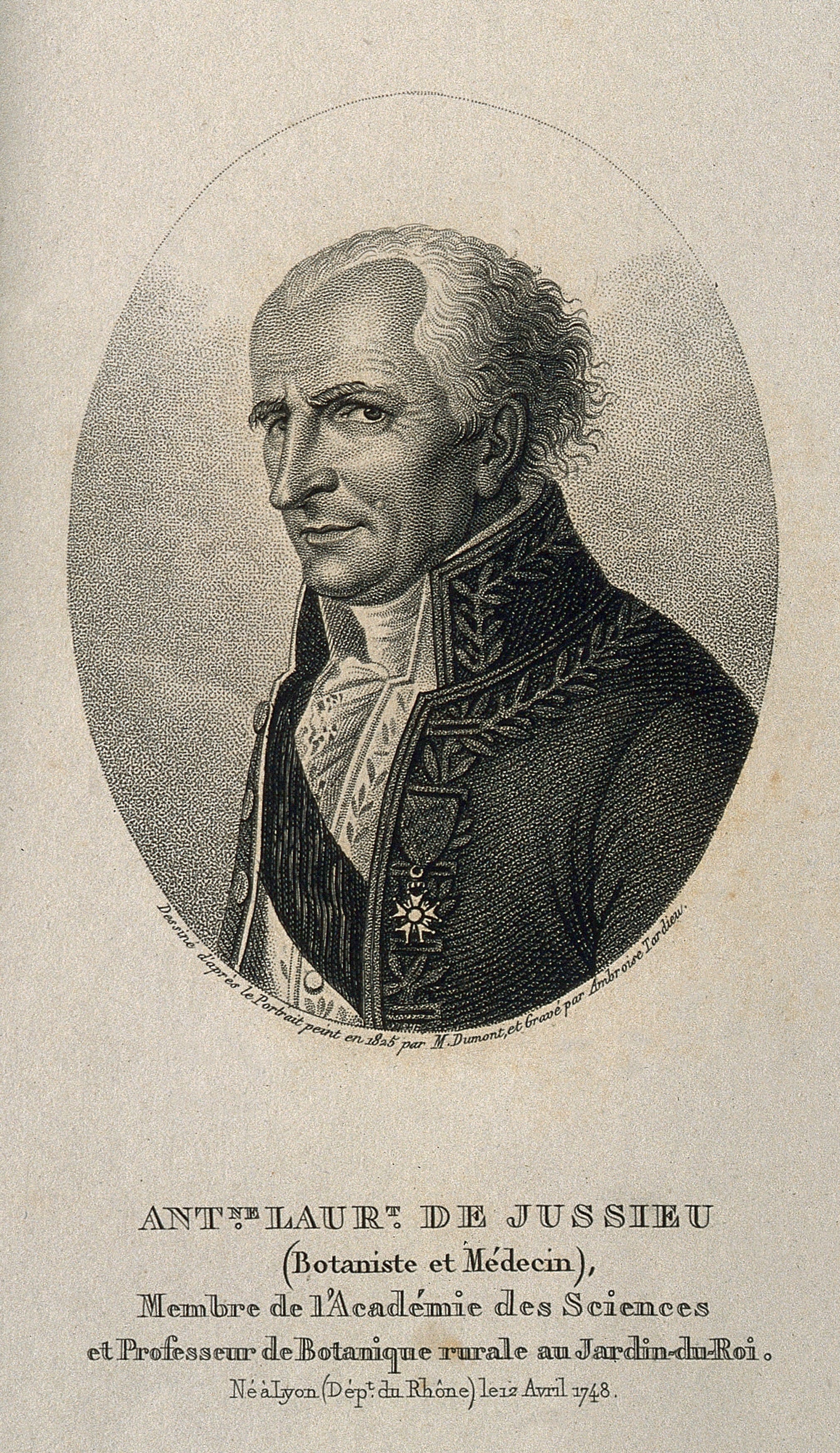
Both verdicts were already present in 1784, inside the investigating bodies themselves. A second commission, drawn from the Royal Society of Medicine, examined the practice in parallel. One of its members, the botanist Antoine-Laurent de Jussieu, declined to sign its report and published his own. The conclusion of his report, dated at Paris, September 12, 1784, reads: “The theory of the magnetism cannot be admitted, so long as it is not developed and supported by solid proofs. The experiments made to establish the existence of the magnetic fluid prove only that man produces upon his fellow man a perceptible action by friction, by contact, and more rarely by a simple approach at some distance.” Jussieu attributed that residual action to the animal heat that passes from body to body, and wrote that a wider and more considered use of the agent would make its true action and its degree of usefulness better known.
Source: A.-L. de Jussieu, Rapport de l’un des commissaires chargés par le Roi de l’examen du magnétisme animal, Paris, 1784; translated from the French of the page images.
After the verdict
The verdict did not end the practice. By 1784 it was carried on across Paris by the pupils Mesmer had trained, and its converts included, the 1785 account records, “some of the greatest physicians and most enlightened philosophers of France.” Nor did the state move to forbid it. Mesmer had refused the commissioners and appealed to the parliament of Paris, asking not that his theory be tested again but that a new commission judge a demonstration he would design; the parliament used the opening to corner him. By its ruling of September 6, 1784, it ordered Mesmer “to expose, before four doctors of the faculty of medicine, two surgeons and two masters in pharmacy, the doctrine, which he professes to have discovered,” to settle “whether there is any difference between his method and Deslon’s.” What the state demanded in public, Mesmer had already sold in private. Since 1783 anyone who wished to learn the method had paid him a hundred louis and sworn to keep it secret; the payments came to more than three hundred thousand livres, many times the earnings of an ordinary lifetime of labor. The statutes of his Societies of Harmony forbade any “publication of the written theory of M. Mesmer, without a consent signed by him.” He never exposed it. He had gone to Spa, a resort town in what is now Belgium, when the report appeared, and left the doctrine where it stood.
But the practice did not stay as the commission had found it. That same year, one of Mesmer’s own followers, the Marquis de Puységur, magnetized a young peasant and, instead of the convulsion, watched him “fall asleep peacefully in my arms, without convulsions or pains.” The calm trance he described that day, not the tub, is what animal magnetism became in the next century. In 1843 an English surgeon, James Braid, gave the trance the name it still holds, hypnotism, and in naming it he threw out the fluid. The effect, he wrote, depended “not at all on the volition, or passes of the operator, throwing out a magnetic fluid,” but on the mind of the subject. Braid’s account was taken up in the French clinics, at the city of Nancy and at the Salpêtrière hospital in Paris, and the hypnosis and suggestion practiced today descend from that work. Mesmerism did not die of the 1784 verdict; it survived by conceding it, keeping the one thing the commissioners had confirmed, that the effect follows the patient’s belief, and letting go of the fluid they never found.
Source: the converts and the parliament’s arrêt of 6 September 1784, from the postscript to the Report of the commissioners, English translation, 1785; the secrecy article of the Réglemens des Sociétés de l’harmonie universelle, Paris, 1785, and Puységur’s Mémoires pour servir à l’histoire et à l’établissement du magnétisme animal, 1784, translated from the French; James Braid, Neurypnology, London, 1843. The 1783 subscription of a hundred louis a head is recorded in Frank Podmore, Modern Spiritualism, 1902.
The commission had established this much. The convulsions were real: the commissioners watched them for months and described them in a physician’s detail. The apparatus contributed nothing: the tub, examined with an electrometer and an unmagnetized needle, contained “no substance either electric or magnetical.” The treatment took effect when the patient believed it was being performed, whether or not anything was done, and it had no effect when the patient did not know it was being performed, even with a practiced operator at work a foot and a half away. The one thing the effects reliably followed was the patient’s belief that the operation was happening.
At that point the two explanations separate, on a question the experiment leaves open: whether the belief manufactures the whole effect, or whether the belief is the channel through which a real influence passes from one human being to another. The commission’s test cannot decide between them, because the test works by taking away the patient’s knowledge of the operator, and on both explanations the effect stops when the knowledge goes. Every later investigation of an instrument said to depend on its operator repeated this structure: the dependence on the human being was confirmed, and the meaning of the dependence was not settled, because the only available test was still the removal on which the two explanations agree. It happened again in a Philadelphia workshop in 1899.
---
Part 3 of “The Occult History of Technology.” Previously: The Magician’s Rule.