

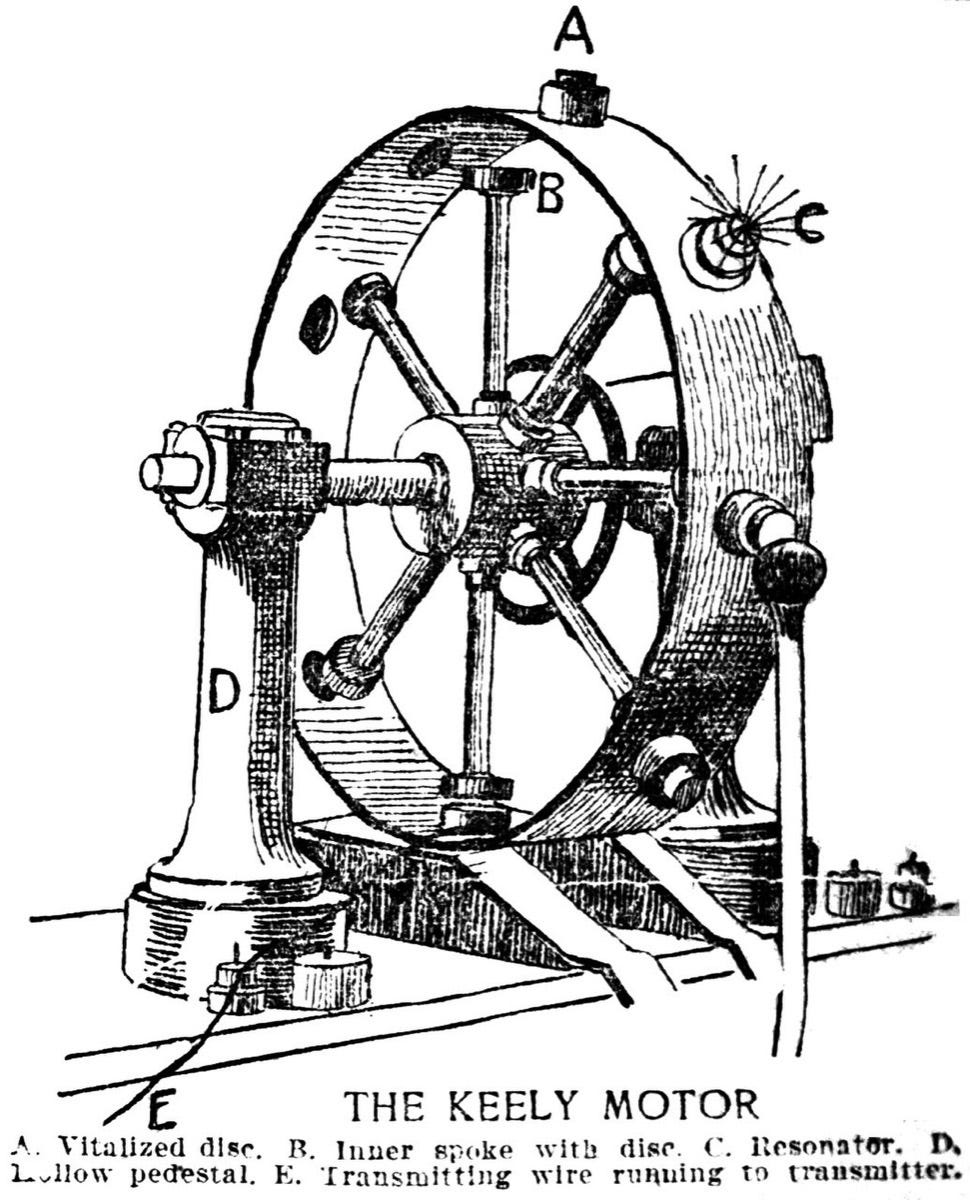
In 1872, in Philadelphia, an inventor named John Worrell Keely announced a motor that ran on no fuel. He claimed to have discovered a new force in nature, released by vibration from a few drops of water. He called it sympathetic vibration, or etheric force. The ether, in the esoteric vocabulary of the period, was a supposed level of nature finer than matter, the carrier of life processes. If the claim was true, coal, steam, and electricity were obsolete. For the next twenty-six years, until his death, Keely demonstrated the force in his workshop before crowds of investors, engineers, and reporters, and a company formed around him sold stock on it. And in all those years, no one but Keely ever ran his machines.
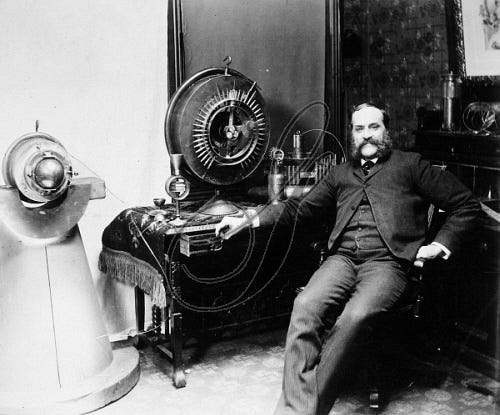
What a demonstration was like is on record from the people who attended. The editor of a technical journal, the Scientific Arena, described one. A weighted lever was rigged so that lifting it would require, by the audience’s own arithmetic, a pressure of many thousands of pounds per square inch, “which we, as well as several others present, accurately calculated. When all was ready, and the crowded gathering had formed as well as possible to see the test, Keely turned the valve-wheel leading from the receiver to the flexible tube, and through it into the steel cylinder beneath the piston, and simultaneously with the motion of his hand the weighted lever shot up against its stop, a distance of several inches, as if the great mass of iron had been only cork.” The session closed with the force fired through a cannon: “a report like that of a small cannon followed, the ball passing through an inch board and flattening itself out to about three inches in diameter, showing the marvellous power and instantaneous action of this strange vapour.”
Source: the editor of the Scientific Arena, quoted in Clara Bloomfield-Moore, Keely and His Discoveries, 1893.
The witnesses were not only reporters and investors. Joseph Leidy, professor at the University of Pennsylvania and one of the most eminent scientists in America, attended a series of experiments and signed a statement on April 8, 1890: “it has appeared to me that he has fairly demonstrated the discovery of a force previously unknown to science. I have no theory to account for the phenomena observed, but I believe Mr. Keely to be honest in his attempt to explain them.” The philosopher James M. Willcox, who signed the same day, claimed more: “He has made manifest the existence of natural forces that cannot be explained by any known physical laws, and has shown that he possesses over them a very considerable control.” Six years later W. Lascelles Scott, an English scientist brought over to examine the machines, was invited to address the Franklin Institute, a scientific society in Philadelphia. Its minutes name his subject “the alleged discovery, by Mr. Keeley, of a new force,” thank him, and record nothing further.
Source: the Leidy and Willcox statements, printed in Bloomfield-Moore, 1893; the Franklin Institute meeting of April 15, 1896, as minuted in the Journal of the Franklin Institute, volume 141.
Exhibitions ran for a quarter century, and “experiments were made by him in the presence of thousands.” What Keely was selling, a hostile paper wrote, was “the monopoly of infinite power without cost, which he dangles before their astonished vision.”
Source: press and stockholder material collected in Bloomfield-Moore, 1893.
The music
In some of the demonstrations, the control was music. The notes were not accompaniment: they operated the machinery, and different notes produced different effects. Among Keely’s instruments were the tuning fork and the zither, a flat wooden box strung with many strings and played by plucking, a parlor instrument rather than a piece of apparatus. The Quintet Club, a club of Philadelphia musicians, visited the workshop after hearing that Keely had “employed the power of music to develop the wonderful forces of nature.” The Chicago Tribune, reporting the visit, wrote that the members “were familiar with the claim made by Paganini that he could throw down a building if he knew the chord of the mass of masonry.” Niccolò Paganini, the celebrated violinist of the early nineteenth century, had boasted of resonance at the scale of architecture: every structure vibrates at some natural rate of its own, and a tone matched to that rate and sustained makes the vibration grow instead of dying out, as a sung note at a wine glass’s own pitch can break the glass. If a player knew a building’s note, its chord, he could in principle play the building down. The musicians went to see whether such a thing had now been done in Philadelphia.
What they saw, in the Tribune’s account: “he caused a heavy sphere to rotate rapidly or slowly, according to the notes given by the instrument on which he played. The sphere was so isolated as to prove that it could not be acted on by electricity or in any other way than by the sound waves. He disintegrated water into what he calls ‘etheric vapour’ by means of a tuning fork and a zither. The disintegration of only four drops of water produced a pressure of 27,000 pounds to the square inch, and three drops of the harmless liquid fired off a cannon ‘with a tremendous roar.’”
The writer saw only two possibilities. “All this is wonderful — if true.” If Keely could do what was claimed, “he has already earned a title higher than that worn by any man of the age.” If he was cheating his audiences, he was “one of the biggest charlatans that ever drew breath.” The writer demanded a scientific investigation, “no matter whether the result be to raise a mortal to the skies or send an alleged angel down to the depths of infamy as a life-long deceiver of his species.”
Source: the Chicago Tribune, reprinted in Bloomfield-Moore, 1893.
The money
In 1874, two years after the initial announcement, organizers formed the Keely Motor Company to turn the discovery into a business. The arrangement was simple: Keely would perfect the motor, and the company’s stockholders would share in the profits of a power that was to make coal and steam obsolete. The engine itself did not exist yet. The company sold stock on the promise of it, and people bought. “There are perhaps a thousand stockholders in the Keely Motor Company,” one of them wrote. The hostile press reported “an issue of 5,000,000 dols. of new stock representing a new discovery veiled in mystery.” Year after year, no engine was delivered. The demonstrations were all the investors ever had.
Source: press and stockholder material collected in Bloomfield-Moore, 1893.
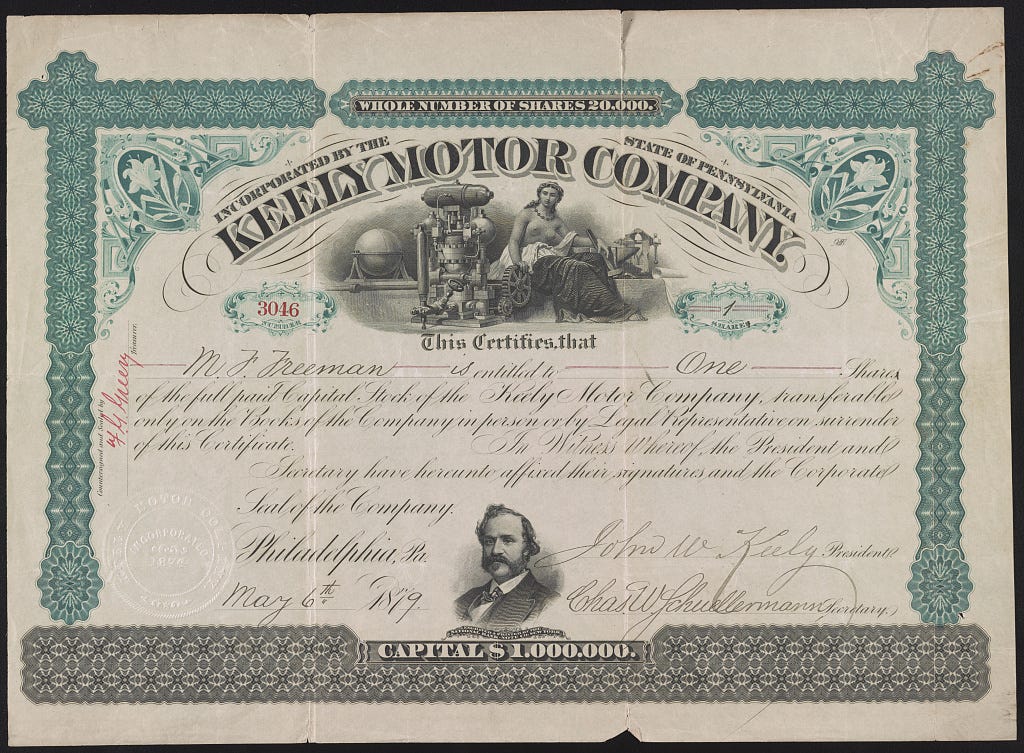
By 1882 the investors had waited eight years, and Keely was sued for failing to deliver on his contract. A court ordered him to make his secret public. He refused, and officers and stockholders of his own company continued proceedings against him through the decade. In 1888 a court appointed a commission of experts and ordered Keely not only to exhibit his machine but to operate it and to explain how it was constructed and how it worked: in effect, to hand over the secret. Keely exhibited the machine and refused the rest, and the judge, Finletter, committed him to Moyamensing Prison for contempt of court. Within three days the state Supreme Court discharged him, ruling the order an excessive use of the court’s powers.
What the jailing produced among his supporters was not doubt but indignation. A Vienna journal that had printed a series of papers on his discoveries wrote of the imprisonment: “The public are still but the children of those who murdered Socrates, tolerated the persecution of Galileo, and deserted Columbus.” His patron Clara Bloomfield-Moore, a Philadelphia philanthropist who funded him for years and collected the record of his case in her book, wrote that “His imprisonment exalted him, instead of degrading him.”
Source: the Vienna Weekly News, quoted in Bloomfield-Moore, 1893; the closing words are Bloomfield-Moore’s own.
And the motor was only the beginning of the claim. In a statement Bloomfield-Moore printed, Keely wrote that once the motor was perfected and patented, “I will devote the remainder of my life to Aerial Navigation, for I have the only true system to make it an entire success in the vibratory lift and the vibratory push-process.”
Source: Keely, quoted in Bloomfield-Moore, 1893.
The condition
In all twenty-six years, the machines ran only in Keely’s presence. Skeptics had an explanation for the wonders early on: hidden compressed air. On that theory, the lever and the sphere were moved by ordinary air pressure, built up in advance and stored out of sight, and the new force did not exist. A stockholders’ committee of his own company reported “deception and misrepresentation” as early as December 1881. And the air theory could be tested. In 1884 Keely was challenged to attach a pressure gauge, the instrument that would have shown whether hidden air was doing the work; he declined, saying “I do not believe in pressure gauges, anyhow.” In 1895 Bloomfield-Moore brought in an examiner of her own, the electrical engineer E. A. Scott. He concluded that a “wire” used in the demonstrations was an air pipe. The direct check was to cut it across, and when the physicist Henry Rowland had asked for that, Keely would not allow it. Nothing was settled. The demonstrations continued, the stock kept selling, and Bloomfield-Moore kept paying Keely’s expenses.
The skeptics were not the only ones with an explanation. The Theosophical Society was the era’s largest esoteric movement, and its founder, the Russian-born occultist H. P. Blavatsky, published its central book, The Secret Doctrine, in 1888, ten years before Keely died. The book devotes a chapter to him, called “The Coming Force.” Where the skeptics called the force a trick, the book calls it real. But the force does not come from the machines. It comes from Keely himself, and if anyone else operated one of his machines, nothing would happen. His discoveries would prove wonderful “only in his hands and through himself.” “It was ‘Keely’s ether’ that acted truly, while ‘Smith’s or Brown’s’ ether would have remained for ever barren of results.” About the engine that never came, the book says: “For Keely’s difficulty has hitherto been to produce a machine which would develop and regulate the ‘force’ without the intervention of any ‘will power’ or personal influence, whether conscious or unconscious of the operator. In this he has failed, so far as others were concerned, for no one but himself could operate on his ‘machines.’” The book presents the missing engine as a prediction fulfilled: “a failure prognosticated and maintained by some Occultists from the first.”
Source: Blavatsky, The Secret Doctrine, vol. I, 1888, the chapter titled “The Coming Force.”
What the investors were paying Keely to build, a motor anyone could run, is exactly what Blavatsky’s book said he could never build.
The floorboards
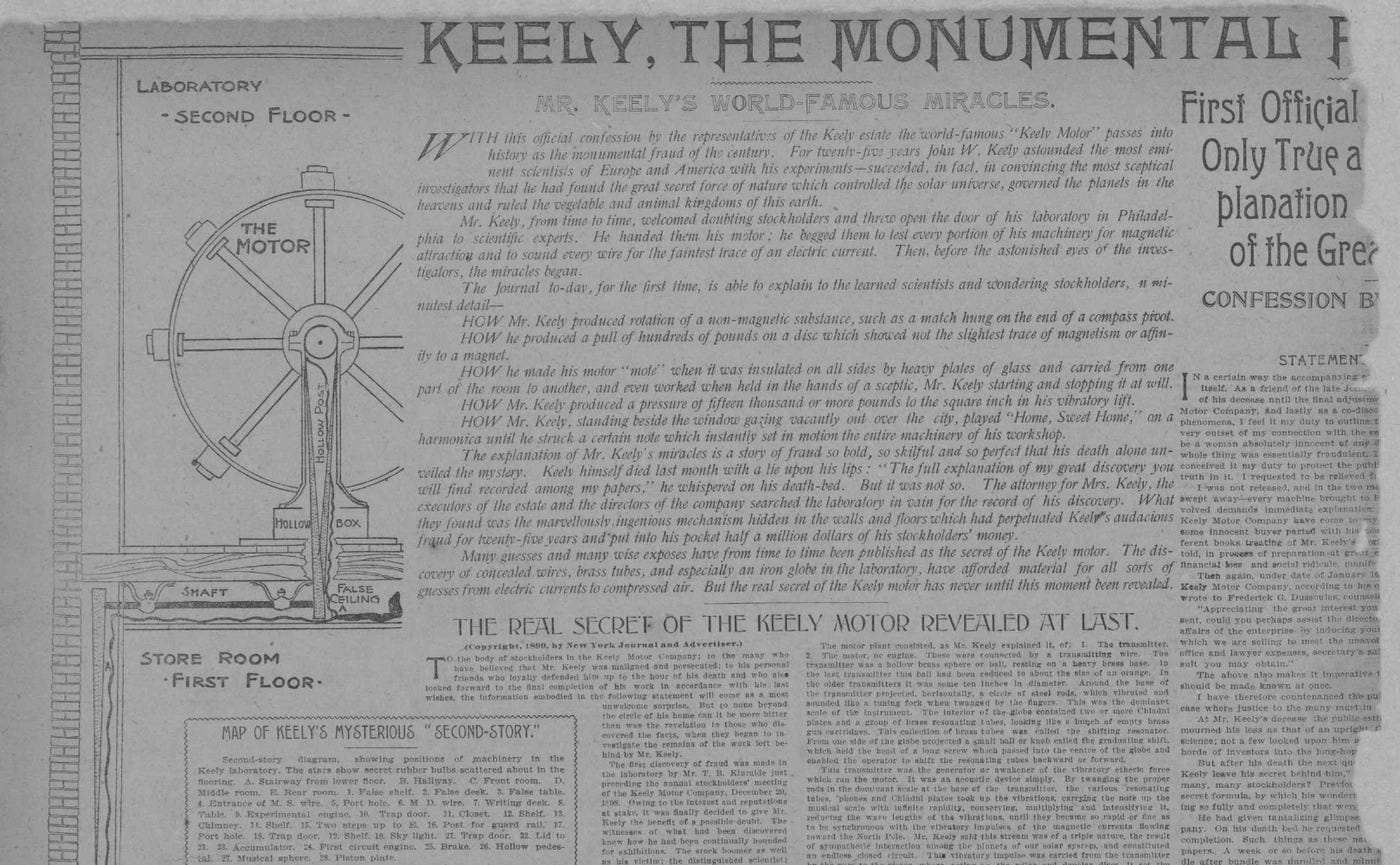
In November 1898 Keely died. The engine had never been delivered, and the secret had never been told. Within weeks, three investigators took up the workshop floor and removed a brick partition: the consulting engineer Carl Hering, the University of Pennsylvania physicist Arthur Goodspeed, and the psychologist Lightner Witmer. They found and photographed concealed brass tubing rated for high pressure, run through walls and bored through solid beams. In the basement they found a three-ton steel sphere, which they judged to be a compressed-air reservoir. Hering signed a statement that the exhibitions had been deception. At the annual meeting of the Engineers’ Club of Philadelphia on January 21, 1899, he “exhibited specimens of tubes and wires obtained in the laboratory of the late John W. Keely.”
Source: Philadelphia Press investigation, January 1899; the Engineers’ Club meeting as minuted in the Proceedings of the Engineers’ Club of Philadelphia, volume XVI.
The exposure ran in papers across the country. The newspapers printed diagrams of what the investigators found. The New York Journal drew the whole workshop in cross-section: the motor in the second-floor laboratory; beneath it a false ceiling, a trap door, and a false floor; and in the cellar a hidden water motor, started and stopped by a concealed rubber tube, its belt and shafts running up inside the wall.
The detail that remains
The fraud verdict and Blavatsky’s book start from the same fact: for twenty-six years the machines ran, and only with Keely present. The investigators said the reason was hidden under the floor. The machines had no power of their own, and Keely drove them with hidden compressed air. Blavatsky said the reason was in the man. On her account the force was real, but no machine could produce it by itself: it acted only through Keely’s own will, something in him rather than in the apparatus. The man was a working part of the machinery, the one part that could not be copied, taught, or sold. That is why no machine of his could ever run for anyone else.
Each answer covers the whole record. If the investigators were right, the demonstrations were compressed air, no engine was ever delivered because there was no force to put in one, and the machines stopped forever because the man running the trick was gone. If Blavatsky was right, the demonstrations were the force, no engine was ever delivered because the force could not be separated from Keely, and the machines stopped forever because the force died with him. Demonstrations, missing engine, dead machines: the record comes out the same either way.
The tubes do not decide it. They show how the demonstrations could have been produced. Whether that is how the demonstrations were produced was never tested: no demonstration was ever run from the tubes, then or later. The one test that would have decided, an examination of a machine while Keely ran it, was the test he refused: the pressure gauge in 1884, the cutting of the wire, the court’s commission in 1888. His death made the refusal permanent.
So the verdict of 1899 ended the Keely Motor Company, and fraud has been the accepted account ever since. But the two explanations were never separated by a test, and now they cannot be. The case closed because the man died, not because the question was answered.
The older and the later record
An instrument that depends on its operator: that is the one fact, and it appears in the record long before Keely and long after him.
Before him, it was a stated requirement, not an excuse. Heinrich Cornelius Agrippa’s Three Books of Occult Philosophy, the standard manual of Renaissance magic, printed in 1533, teaches that the prepared human being is the working part of every operation, that the instrument fails for any other operator, that it cannot be transferred, and that it dies with its operator. Keely’s motor, on those terms, behaved as specified.
Around him and after him, investigators kept confirming the fact and kept dividing over its meaning: a royal commission in Paris in 1784, an American chemist testing his own apparatus in 1855, a university commission in 1887, an American courtroom in 1951, the High Court in London in 1960. And the machines of the present are built for the opposite condition: to work the same for anyone.
---
Part 1 of “The Occult History of Technology.”