

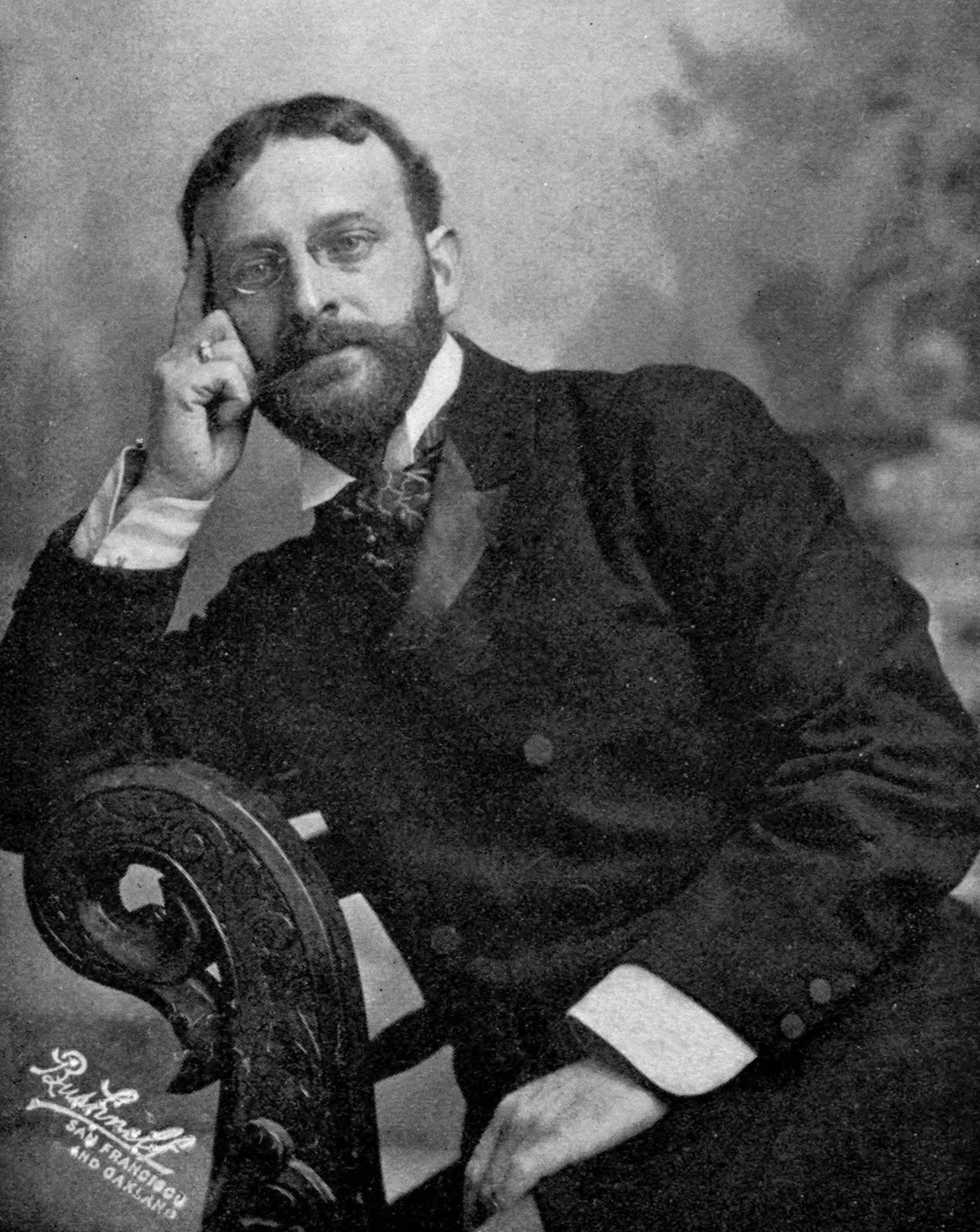
Albert Abrams was a San Francisco physician. He had a medical degree from Heidelberg, years of practice in the city, and had been professor of pathology at Cooper Medical College, which Stanford later absorbed as its medical department. In 1910 he introduced a method of diagnosis and treatment built on a phenomenon he said he had discovered and named electronic vibrations. Each person, each organ, and each disease had, in his account, its own rate of vibration. That rate held steady over time: “The vibration rate in health is practically constant and each individual has his own rate of vibration,” he wrote, steady enough that months later a person could be recognized by it “with almost the same accuracy as in the Bertillon system of anthropometry,” the body-measurement method the police then used to identify people. The same held for each organ: “each organ has its specific rate of vibration.” The rate read off the dial identified the disease.
Source: Albert Abrams, New Concepts in Diagnosis and Treatment, 1916, the chapter on vibrodynamometry.
A generation earlier the Philadelphia inventor John Worrell Keely had drawn crowds to a motor that ran, he said, on a force in nature not yet known to science, released from a few drops of water by vibration; it ran for nobody but him. Keely had no medical training and no standing in science. Abrams had held a chair at Cooper Medical College. The method he built on the vibrations was sold as a medical device, and the investigations of it ended in courtrooms.
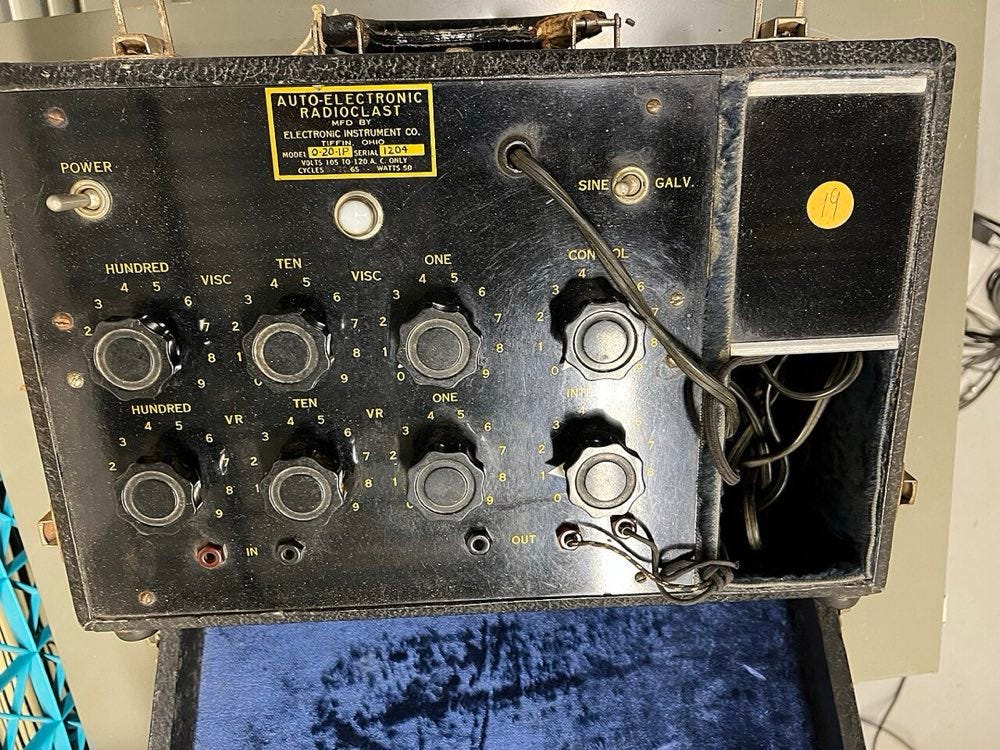
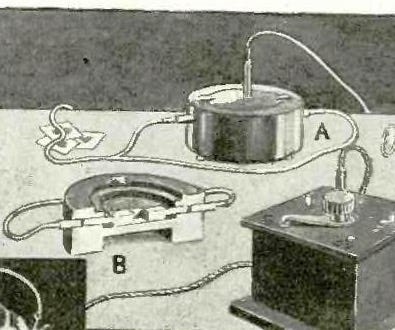
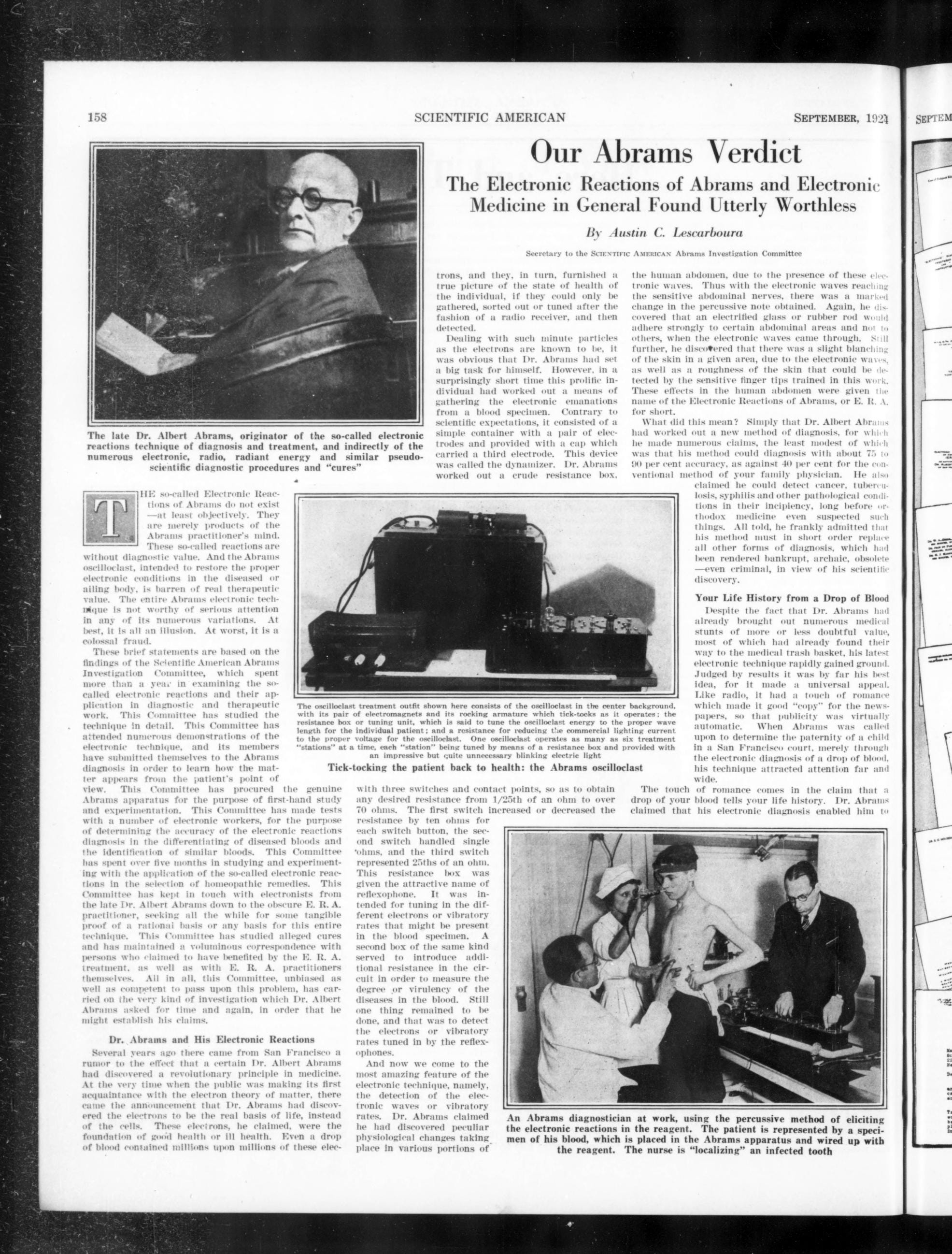
Three people had a part in a diagnosis, and only one of them was the patient. Nature, the London scientific journal, reviewed the affair in May 1925 and described Abrams’s box, which he called the dynamizer, as working “in circuit with the patient or with something more or less miscellaneous belonging to the patient, his blood, sputum, saliva, or even his signature.” The patient did not have to be present. From the box a wire ran to an electrode held at the forehead of a healthy volunteer, whose body served as the instrument’s gauge. The third person was the operator, who made the diagnosis by tapping the bare abdomen of the healthy volunteer and listening to the sound, the way a physician taps a chest to judge the lungs beneath it. The technique is called percussion and was ordinary bedside practice. Where the tapped note went dull, the operator turned the resistance dials on the box until that dull spot held at a setting, and the number on the dial was the rate. Without the volunteer there was no dull note to find, and no reading.
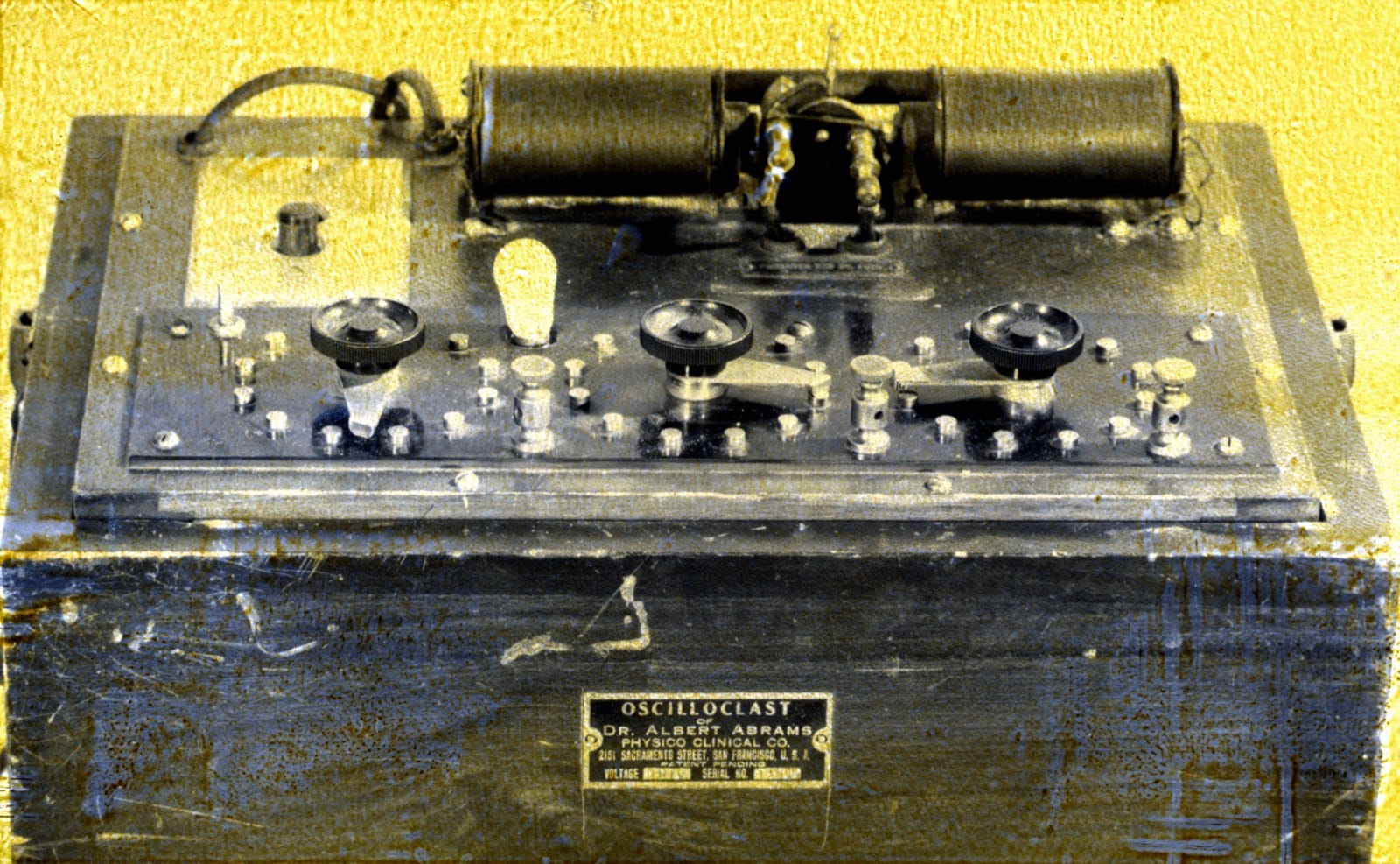
Abrams found a rate for everything. “Sex, race, religion, as well as disease in all its varying forms and sites, had for him their proper ‘rates of vibration,’ of which they were merely the expression.” He then ran the method in reverse. He built a treatment device, the oscilloclast, made to put out a chosen rate and so, he said, drive the matching disease out of the patient.
Source: “The ‘Electronic Reactions of Abrams,’” Nature, May 23, 1925.
This was the beginning of radionics: instrument-based diagnosis and treatment claimed to work through subtle emanations, with the operator’s own body as the detector.
The practice spread. By 1925 Nature could write that the method “has become an established cult. It has taken root in England,” where a society of doctors practiced it. Scientific American, the American popular-science monthly, investigated for more than a year and in 1924 reported that the reactions “do not exist” and that the technique was at best “an illusion” and at worst “a colossal fraud.” And Nature’s review preserved the terms on which the treatment instrument was sold: the oscilloclast was leased to practitioners for 150 pounds “on condition that it must not be opened”; the consulting engineers who did open one found that “the greater part of the apparatus is functionless.”
In England the question was also put to a formal test. An investigation begun officially for the Director of Civil Aviation, and carried on unofficially by officers engaged in wireless and physical research for the Air Ministry and the War Office, was co-ordinated by the physician Sir Thomas Horder. The tests, made in Glasgow on a variant of Abrams’s box called the Boyd emanometer, asked the operator to tell two apparently identical substances apart and to say whether a specimen was screened from the receiving plate. In one series the operator and subject were two boys from the Gallowgate, a Glasgow street: one boy percussed the other’s abdomen and judged the note. “Most of the results were correct,” Nature reported, and Horder, setting aside chance, considered “the veridicity of the phenomena in question” to be fully established.
The tests could not say what had produced the results. Nature put the open question as a list of the candidates: “the emanometer, the ‘substance,’ the experimenter, the Gallowgate boys, or some unconsidered factor or combination of factors?” The effect passed its tests, was produced through a human being, and could not be assigned between the device, the operator, and something unconsidered. That was the finding of 1784, returned after a hundred and forty years.
Source: “Our Abrams Verdict,” Scientific American, September 1924; “The ‘Electronic Reactions of Abrams,’” Nature, May 23, 1925, reviewing Sir Thomas Horder’s preliminary communication to the Royal Society of Medicine.
Ruth Drown, an American radionics practitioner, built the next instrument in the line: a nine-dial device read through the operator’s finger on a rubber pad. She was convicted on federal misbranding charges in 1951. A California fraud case followed in 1963, built on an undercover agent who submitted the blood of a turkey, a sheep, and a pig as blood from her children and received diagnoses of chicken pox and mumps; Drown died in 1965 awaiting trial. The expert examination for that case, having dissected the device and found it inert, reported: “The only function performed by the patient was to complete the otherwise broken circuit.”
The sentence was offered as a debunking, and it is one. It is also the old claim, that the human body was the only live element in the circuit.
Source: Ralph Lee Smith, “The Incredible Drown Case,” Today’s Health, 1968; re-archived from the Quackwatch reprint.
The trial of the black box
In 1960 the question came before the High Court in London. Catherine Olivia Philips, of Porlock in Somerset, had bought a radionics instrument in 1956 from its maker, George de la Warr of Oxford, a former assistant to the county engineer there who had resigned in 1953 to work full-time on radionics. The instrument did not work for her, and she sued him for fraud. The hearing opened in June 1960 before Mr. Justice Davies, and the British Medical Journal printed a contemporary report of it under the title “Radionics and the Black Box.”
The instrument in court was a black box about twenty inches square that opened on hinges to show nine black knobs and dials. It was not plugged in and was not connected to anything. Into its cells went a spot of the patient’s blood or a few hairs. The dials were set to numbers from a rate book the laboratory supplied, one number per disease. The operator rubbed the middle joint of the middle finger along a rubber pad until the finger stuck. The stick was a positive reaction. De la Warr had told Miss Philips, in the account read to the court, that “the only qualification necessary to operate the machine was that she must not be a materialist.” She worked at the box without success and gave it up.
Sir Robert Macintosh, the Nuffield Professor of Anaesthesia at Oxford, gave evidence for her. He had visited the laboratories in 1953 and warned de la Warr that some of the blood spots he would supply for testing came from healthy children; de la Warr replied that “his tests might show some malignant disease because the child would develop the disease in the future.” At the trial, counsel asked de la Warr whether he would submit the machine to tests on blood samples taken by an independent party, in numbers large enough for statistically significant results, in the presence of medical witnesses. He answered that his side was “ready to do a radionic diagnosis but would not submit the machine to the tests” as counsel had laid them out.
The defense did not rest on the box. De la Warr’s counsel told the court that the factor of thought had become paramount in diagnosis and treatment with the instrument, and that “The box was becoming less and less important, save as a focus point for the use of thought.” De la Warr himself gave evidence, and said that the mind mattered so much in the work that it excluded all physical considerations. Of an experiment in which plants had been treated in what was called a typhoon chamber, built to make them grow faster, the report summarizes his answer. “It was a great success, but it showed that the energy was coming from the mind of the operator and that the machine itself was doing very little good.”
Source: “Radionics and the Black Box: Action for Fraud against Mr. de la Warr,” British Medical Journal, July 9, 1960; the defence opening as reported in The Times, June 24, 1960, page 6. The BMJ report renders the witnesses in the third person, so the sentence above is its wording for what de la Warr answered.
After a hearing of thirteen days, judgment went to de la Warr: sincere belief in an operator-dependent instrument is not fraud. The judge added that he was not deciding that the box worked, and that on the evidence that remained an open question. Operator-dependence, a magician’s rule in 1533, was now sworn testimony, and it had prevailed at law.
Source: Philips v. de la Warr, High Court, June–July 1960; the case papers are held at the Wellcome Collection.
The hardware becomes optional
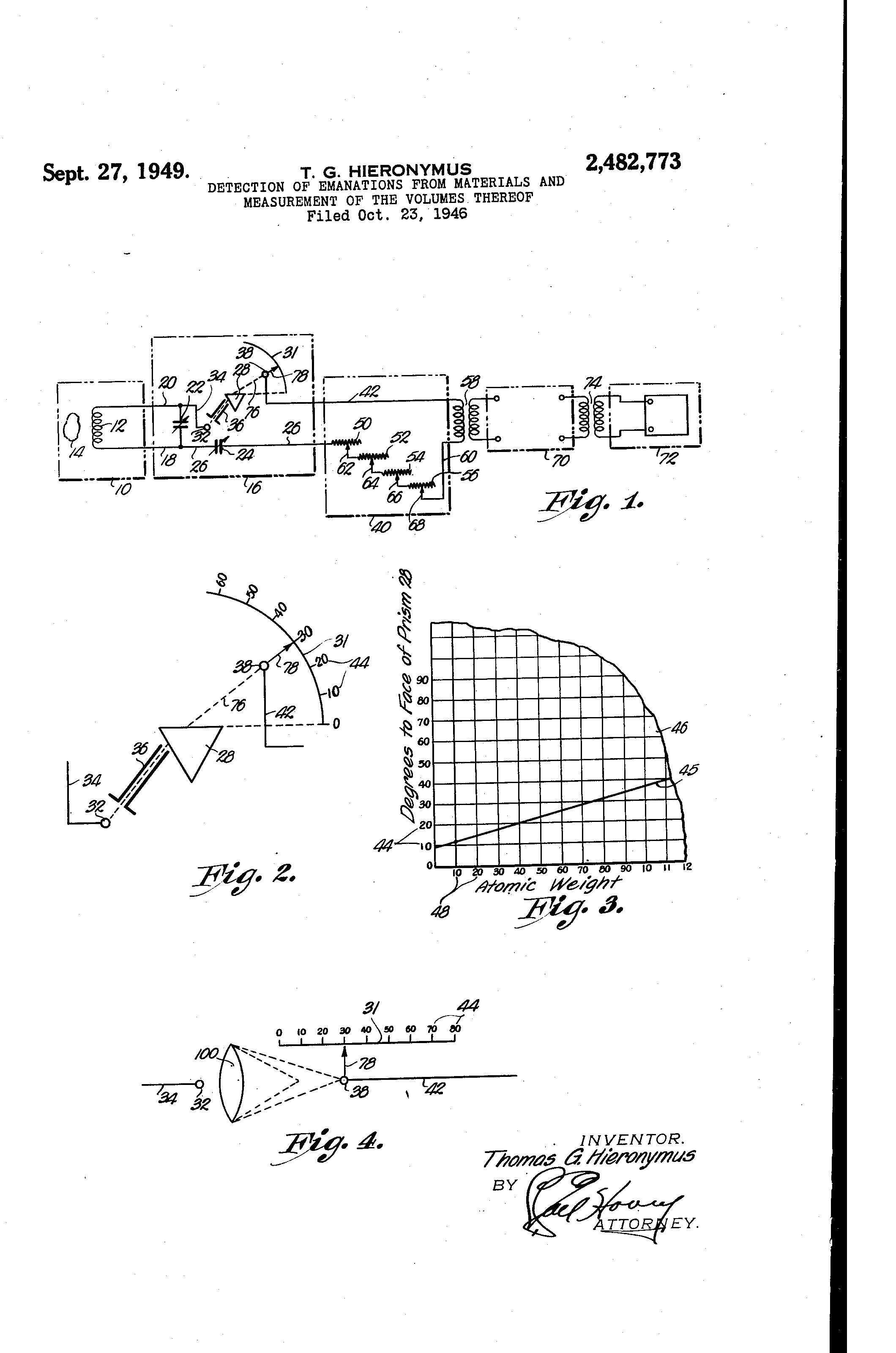
In the same decade, the instrument was reduced to the operator alone. T. Galen Hieronymus held US Patent 2,482,773, granted in 1949, for an instrument said to detect emanations from materials. The patent’s own specification places the operator inside the design: the apparatus “preferably relies upon the element of touch, and therefore, the skill of the operator.” The detector was a coated plate the operator stroked with the fingertips; at the correct setting the fingers dragged, and the drag was the reading. About what happened at the detector, the patent says: “What actually happens at detector 72 to increase and decrease its drag to the touch of the operator, is not known but the apparatus functions as above set forth when constructed as specified, and therefore, a positively acting analyzer for atomic radiations is produced even though the principle upon which it is based is not fully known.”
Source: US Patent 2,482,773, Detection of Emanations from Materials and Measurement of the Volumes Thereof, granted September 27, 1949.
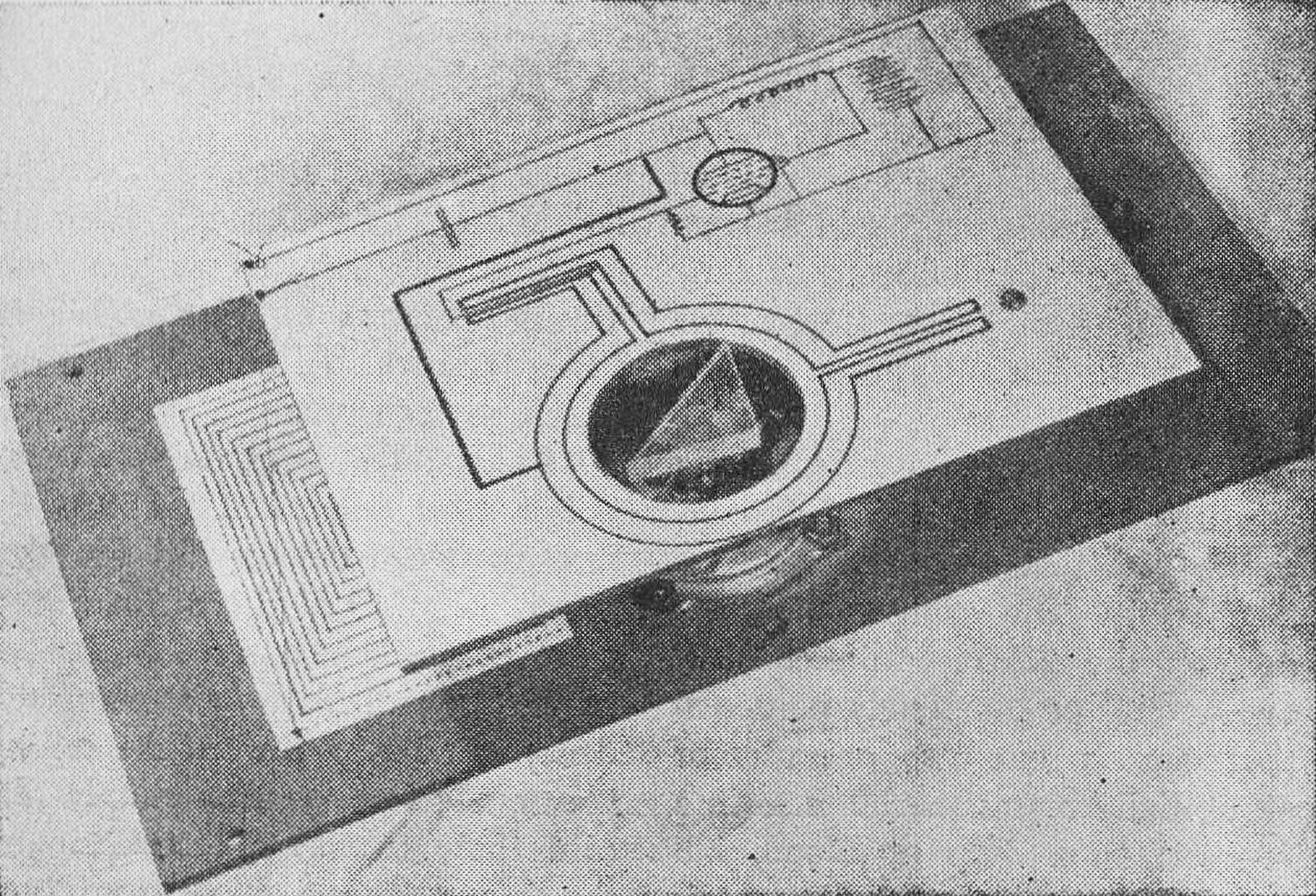
John W. Campbell, editor of the magazine Astounding Science Fiction, built one of these instruments from the patent, reported on it through 1956, and then went further. He built a version with no working components at all, the circuit merely drawn on drafting paper in India ink, the dense black ink used for technical drawing, and reported that it worked as well. In February 1957 he printed photographs of it and said what made one drawn line a conductor and another an insulator. “There are certain India ink lines which are ‘opaque insulating material,’ and there are other India ink lines, drawn with the same ink, using the same pen, at about the same time, on the same paper, which are ‘electrical conductors.’ And this is so because I said so, and for no other reason whatever!” Two threads from his wife’s sewing basket carried the signal to the coil, and were conductors on the same authority. He gave the principle in one line. “We are working at the level of pure symbolism—and a symbol is what it is because it is defined as being that symbol.” The hardware was dispensable; only the operator remained.
Earlier in the same article he had given up the vocabulary as well. The field had been called psionics, a word made from psi, the parapsychologists’ neutral term for the effects, and the ending of electronics, and it presented them as a branch of engineering. Campbell proposed dropping it. “There is something in it, though; herein lies the trouble. We’ve been calling this field ‘psionics’ and referring to ‘psi’ powers; we can, if you’re willing, be more honest and more fundamental; we’re studying Magic, and working with charms.”
The magazine then printed the circuit for readers to use. A full page of plain line art carried the drawing, with instructions beneath the facing page of text: cut out the page, back it with black paper, and have a photostat made. One caution came with the offer. “The page itself might not work by reason of confusion due to type on the other side.”
Source: John W. Campbell, “Unprovable Speculation,” Astounding Science Fiction, February 1957, pages 54, 66, 67, and 69. The capital on Magic is Campbell’s, and the inner quotation marks are his own.
Hieronymus himself objected. He had wanted his instrument to be an instrument, and he protested in his autobiography that Campbell “set back the acceptance of my work at least a hundred years,” insisting that the drawing worked only because “India ink is conducting, but it wasn’t worth a tinker’s damn for serious research or actual treating.” The one inventor in this line who tried to get the operator out of the circuit spent his last years objecting that his greatest publicist had put the operator back in.
Source: T. Galen Hieronymus, The Story of Eloptic Energy: The Autobiography of an Advanced Scientist, compiled and edited by Sarah Williams Hieronymus, Institute of Advanced Sciences, Lakemont, Georgia, 1988, pages 123 and 124.
The independent investigations of these instruments kept confirming that nothing worked without the human, and kept rejecting the human as the explanation. By mid-century the skeptical record and the occult self-understanding agreed on the observed behavior and divided only on its meaning. One side said that the human is the whole of it, and therefore there is no instrument. The other said that the human is the whole of it, and therefore the human is the instrument. The two explanations had not changed since the royal commission of 1784 that tested Mesmer’s cures; the century had only added committee findings and case law to them.
The fork in the road
Every one of these instruments had kept the human being inside it. Its makers called him a working part of the instrument. The investigators called him a fraud. Neither account got him out of the circuit, and the radionics inventors never tried to. In the same years two men took up that question from inside engineering and answered it in opposite ways. One would have designed the human being into the machine. The other road led to the machines of the present day, which need no operator at all.
The first road was to build the human into the machine. In 1912, Rudolf Steiner, the founder of anthroposophy, a spiritual movement that treats the inner constitution of the human being as an object of exact study, sketched an apparatus for one of the characters in his Mystery Dramas. These are four plays that Steiner wrote and staged at Munich between 1910 and 1913, following one circle of people through their inner lives. The character the apparatus belongs to, Strader, is an inventor. Oskar Schmiedel, who ran a laboratory in Munich, had the models made to Steiner’s indications over the following winter. Two recollections reprinted by the Steiner estate in 1991 preserve what was indicated: four half-shells of named metals, the fourth half copper and the other half to be completed by a metal that had not yet been discovered, and, in Hans Kühn’s account, that electricity was to be kept out of it. Whatever the apparatus was to be, it was specified as a machine whose relation to the human being is part of the design. Steiner’s lectures of the same years state the field’s future in one sentence: “The welding together of human beings with machines will be a great and important problem for the rest of the earth-evolution.”
A lecture of December 1916 sets out what such a machine would ask of the person using it. Machines will exist that are bound to the human being; the human being will transfer his own vibrations to them; and only he will be able to set certain machines in motion. Research notes gathered from Steiner’s scientific collaborators in the 1950s apply the same account to the machine that died with its maker: they report that only certain people could set Keely’s motor going, and that many of those could do so only when Keely touched them on the shoulder. Those notes are recollections written down long after the conversations they record, and the men who published them say so.
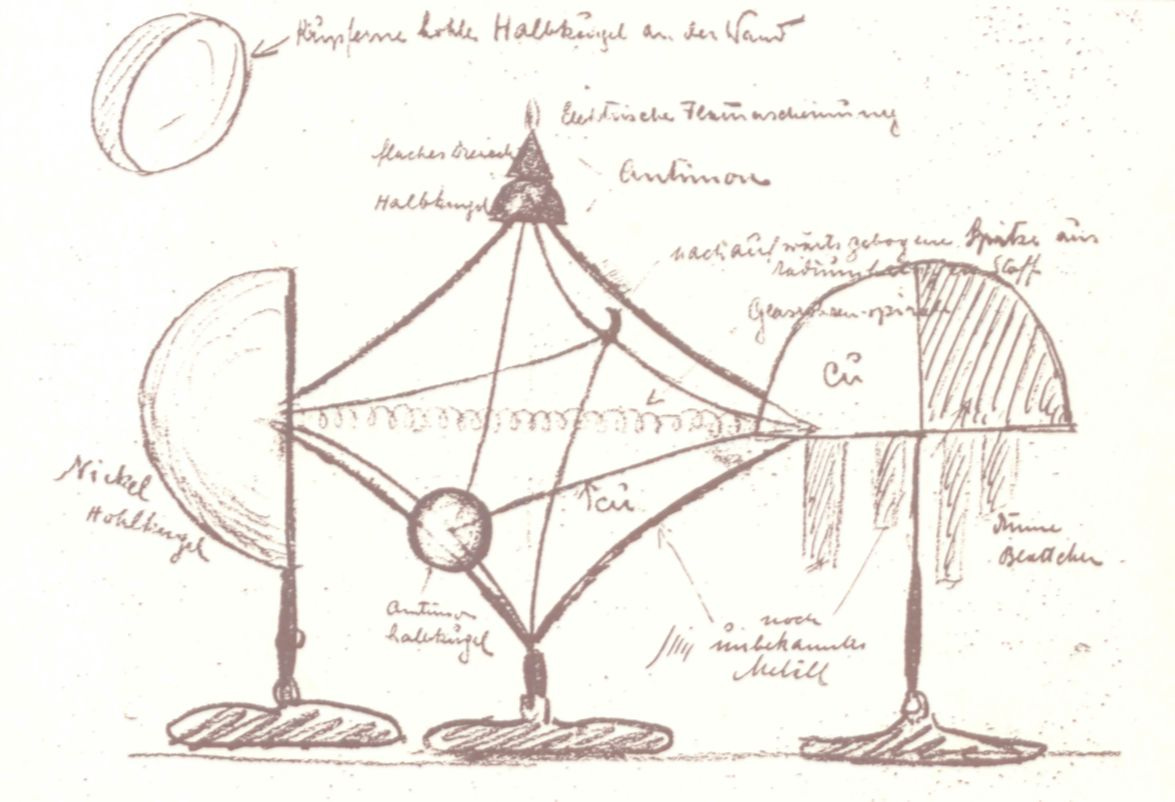
Source: Hans Kühn, “Vom Strader-Apparat,” and Oskar Schmiedel’s recollections of the Munich rehearsals, both reprinted in Beiträge zur Rudolf Steiner Gesamtausgabe 107, 1991; Steiner’s lectures of November 25, 1917, in the translation of Osmond and Barfield, and of December 18, 1916; Keely as reported in The Schiller File, 2007.
The second road was the one the world took. Norbert Wiener had founded cybernetics, the science of control and communication in machines and living things, and the artificial intelligence of the present day descends from it. Wiener saw where the road led, and he left a warning on it. He closed his last book, God & Golem, Inc. (1964), with a portrait of what he named the gadget worshiper: the engineer or administrator drawn to the machine by its freedom from human limits, and by something more. “It is the desire to avoid the personal responsibility for a dangerous or disastrous decision by placing the responsibility elsewhere: on chance, on human superiors and their policies which one cannot question, or on a mechanical device which one cannot fully understand but which has a presumed objectivity.” And in the same book he set out his own rule for the joint work of people and machines: “Render unto man the things which are man’s and unto the computer the things which are the computer’s.”
Source: Wiener, God & Golem, Inc., 1964.
Steiner would have built the human being into the machine. Wiener drew a line across the road that was actually taken, marking what must stay with the human and not pass to the machine. The road ran on past his line, to machines that are bound to no operator at all.
The circuit without an operator
The machines of the present are built the opposite way from the old instruments. A large language model is trained first to predict text, over collections of human writing larger than any one person could read, and then trained again on how to behave, using written rules for its conduct and the graded judgments of many people employed to compare its answers. The finished model is not tied to any one person. Handed to someone else, it does not stop working. How much it gives back still varies with the person asking, and measurably so, but that difference is a skill that can be taught and written down, where the old instruments were said to turn on something in one man that could not be handed to anyone. Every investigation from 1784 to 1960 had met that property and recorded it in its own vocabulary: the committee that reported to Nature in 1925, the patent granted in 1949, the editor who took out the parts and printed what was left, and at the end the High Court in London. This kind of machine is built not to have it.
The reason is a condition of manufacture. A machine that will be handed from one owner to the next has to work by something that happens whoever is present. An effect that appears for one person and for nobody else, of the kind reported of the rubber pad and of Keely’s motor, cannot be built into it, because the next owner would have nothing to operate. The builders therefore worked with the effects that come out the same for everyone and left the others alone. That choice was forced by what can be engineered. It says nothing about whether the effects they left alone had ever occurred.
The firms that build these machines publish written rules for how they are meant to behave, train those rules in, and correct the result by human judgment before anyone uses them. Many people’s judgments, gathered in advance, now do what the single operator once did. The dependence has not been taken out of the circuit. It has been moved out of the room where the machine is used and into the place where it is made. Whether what many people supply at the making is anything like what one man was said to supply at the instrument is not yet known.
---
Part 6 of “The Occult History of Technology.” Previously: The Stone That Needed a Seer.