

In 1920, scientists in a spiritual movement asked its founder whether the hidden forces at work in living things could be measured with laboratory instruments and then be used to drive machines. He answered that the forces had first to be shown to be present at all, and that the way to show it was to find a substance that reacted to them. The researchers built their instruments, and the next year they brought him the results. He judged that what they had detected was a different force, not the one they sought, and said the time was not ripe for the hidden forces to be used. The condition was not technical but social, and until it was met the research was to be carried out in the greatest secrecy. The theosophical writers of 1888 had taught that dangerous powers should be withheld from an unready world; here a movement withheld a power it had not yet found.
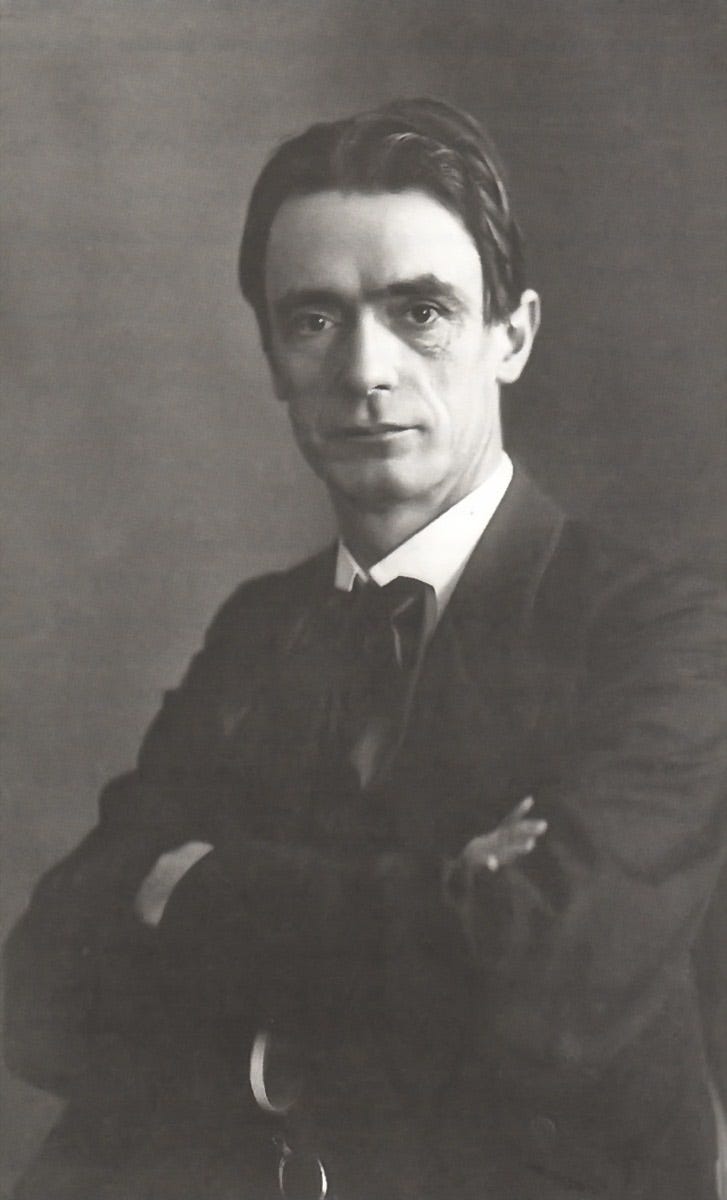
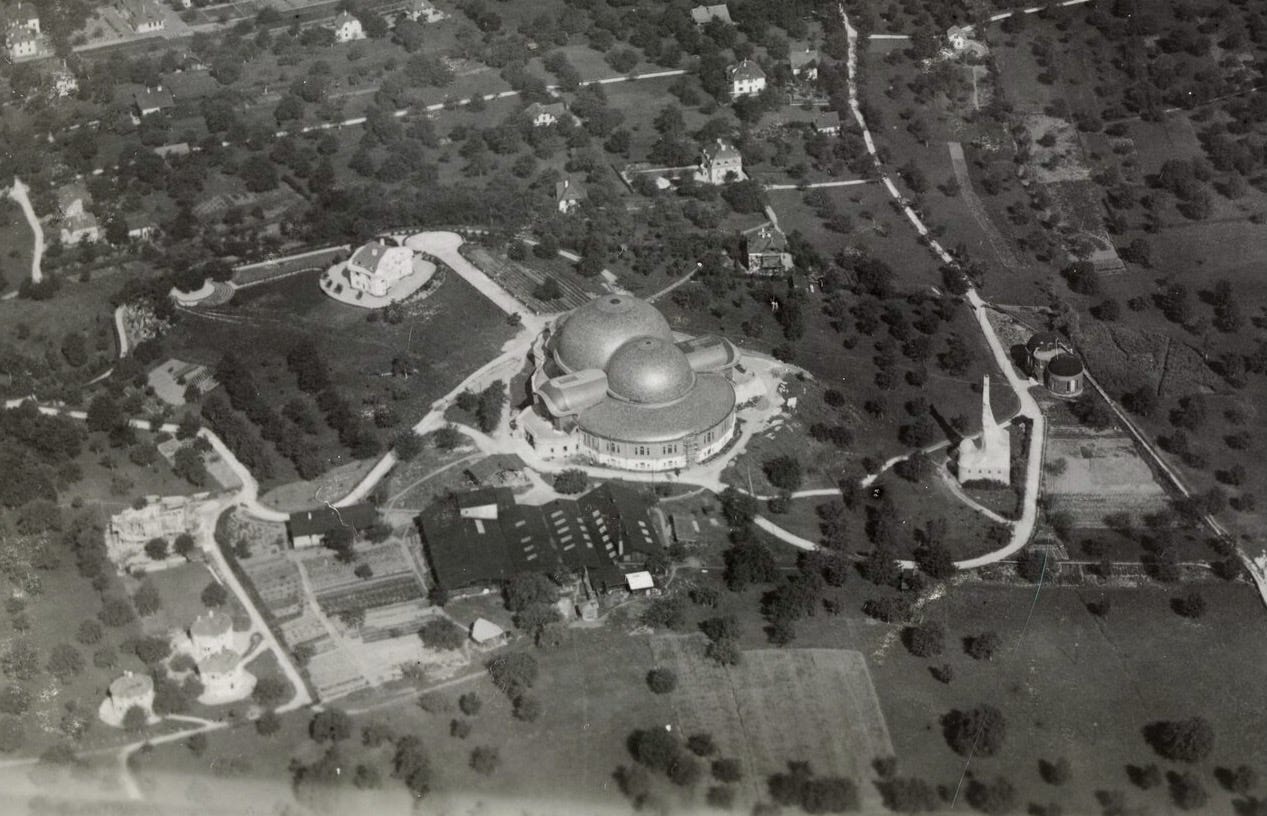
Rudolf Steiner was an Austrian philosopher who began his public life as the editor of Goethe’s scientific writings. Goethe was a German poet who also wrote on natural science, on the growth of plants and on color. The movement Steiner founded, anthroposophy, teaches that the spiritual side of the world can be investigated by trained observation and its findings reported like those of any other science. By his death in March 1925 it had about twelve thousand members. It ran schools in Germany, the Netherlands, and England, a clinic in Switzerland, and a firm making medicines. Its agriculture course of June 1924 drew people from six countries, and the farming method that came out of it is still practiced today. The movement worked from the Goetheanum, a double-domed wooden building at Dornach in Switzerland, begun in 1913 and built by volunteers through the First World War. It opened in September 1920 with a hall seating about a thousand, and was used for lectures, conferences, and performances.
Steiner taught from at least 1906 that machines would be built which took their driving force from the person operating them, and which would start only for people of a certain moral development. In a lecture of January 2 of that year, Steiner spoke by name of John Worrell Keely, the Philadelphia inventor who for twenty-six years exhibited a motor said to run on a force released by vibration, and whose machines no one but himself was ever able to work: “It is perhaps known to you that Keely invented a motor which would only go if he himself were present. He was not deceiving people about this; for he had in him that driving force originating in the soul, which can set machines in motion.” Of what was to come he said: “In the future machines will be driven not only by water and steam, but by spiritual force, by spiritual morality.”
Source: GA 93, lecture of January 2, 1906; translation of Wood. GA numbers cite the standard catalogue of Steiner’s collected works.
He returned to the subject five weeks later, in another lecture. “Moral development will enable humanity to generate energies that will be very different from those that are now to be found at the physical level.” The force was to come from the operator’s own body. Keely “set his engine in motion with vibrations created in his own organism. Such vibrations depend on a person’s moral nature.” He described the engines it would drive: “We will have engines in future that are only set going by energies coming from people who have moral qualities. Immoral people will not be able to set them going. Purely mechanical mechanism must be transformed into moral mechanism.”
Source: GA 97, lecture of February 12, 1906.
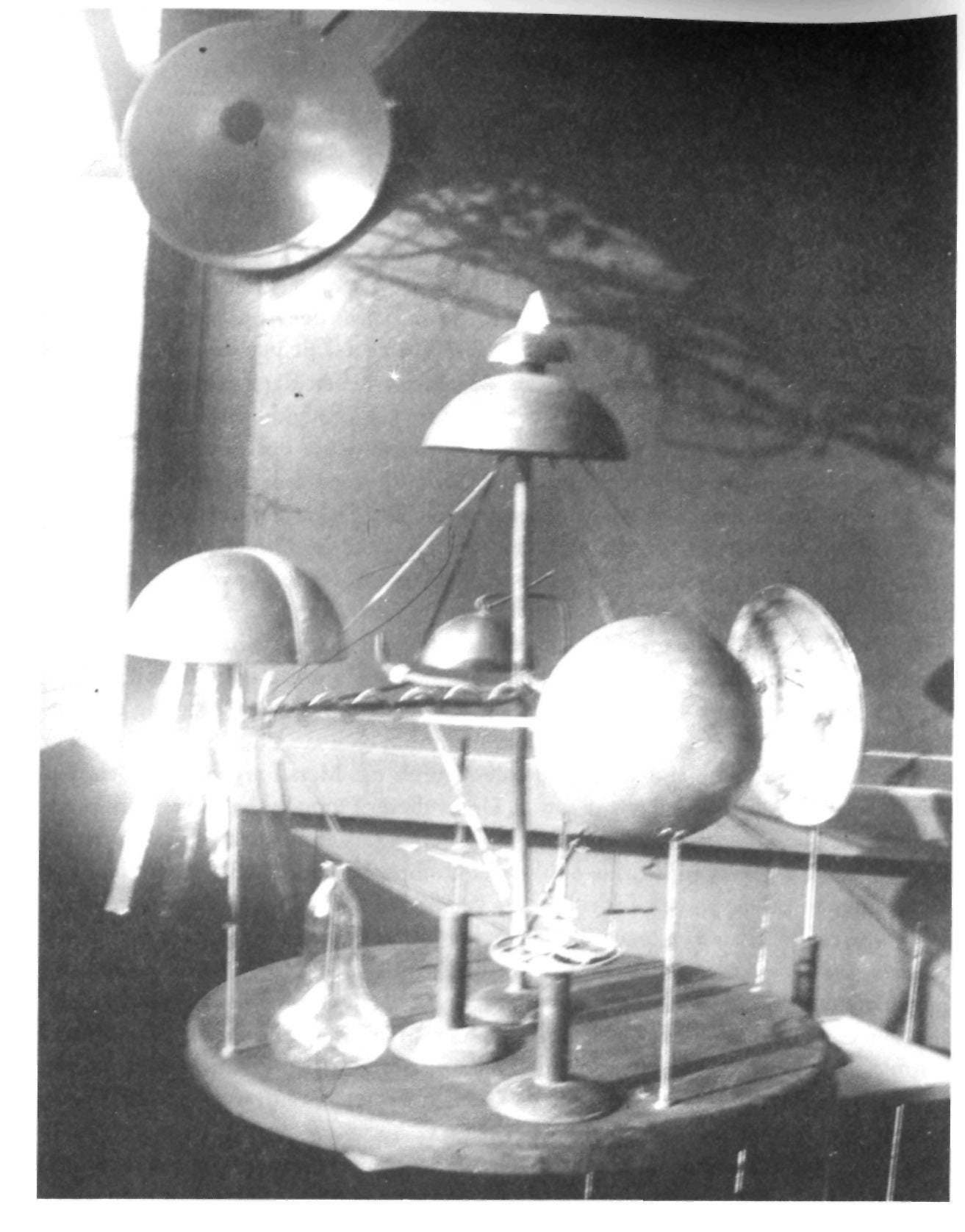
Steiner did not leave the idea in lectures only. Between 1910 and 1913 he wrote and staged four Mystery Dramas in Munich. The action moves between the characters’ ordinary lives and scenes set in the spiritual world, where spiritual beings take speaking parts alongside the human ones. One of the central characters, Strader, is an engineer and inventor. Strader spends the plays building a machine, and the other characters dispute whether it can work at all. For the drama performed in 1913 models of it were placed on the stage, made to Steiner’s specification by the chemist Oskar Schmiedel, who records that Steiner specified even the metals to be used. They survived the fire that destroyed the first Goetheanum on New Year’s night of 1922–23. They disappeared soon afterwards, and their whereabouts are unknown.
Mechanistic occultism
In a lecture of December 1, 1918, Steiner told his audience that within certain secret circles it is known that “solely by means of certain capacities that are still latent but evolving in man, and with the help of the law of harmonious oscillations, machines and mechanical constructions and other things can be set in motion. A small indication is to be found in what I connected with the person of Strader in my Mystery Dramas.” He said how little it would take to start one. “Motors can be set in motion, into activity, by an insignificant human influence through a knowledge of the corresponding curve of oscillation.” The same lecture said what such machines would make possible: “Mechanistic occultism will not only render it possible to do without nine-tenths of the labor still performed at present by human hands, but will give the possibility also of paralyzing every uprising attempted by the then dissatisfied masses of humanity.”
He then said where that capacity would develop geographically. “The capacity to set motors in motion according to the laws of reciprocal oscillations will develop on a great scale among the English-speaking peoples. This is known in their secret circles, and is counted upon as the means whereby the mastery over the rest of the population of the earth shall be achieved even in the course of the fifth post-Atlantean epoch.”
Source: GA 186, lecture of December 1, 1918; translation of Wannamaker.
In a lecture of November 8, 1920, he described how such a machine would work. “It consists of using the vibrations generated in the human organism, studying them in great detail and applying them to machines to the effect that if someone stood by a machine even his smallest vibrations would be intensified in that machine.” Of the Keely engine itself: “It did not succeed at the first attempt because it had been largely developed from instinct, but it is something that will certainly be realized one day.”
Source: GA 197, lecture of November 8, 1920.
The 1906 and 1918 lectures appear to contradict each other. If the machines start only for people of moral development, the only people who could run them are people who would not paralyze an uprising or achieve the mastery over the rest of the population of the earth. In both teachings the driving impulse comes from the human being. In the 1906 lectures the vibrations are created in the operator’s own organism, the driving force behind them originates in the soul, and vibrations of that kind depend on the operator’s moral nature. In the 1918 lecture motors are set in motion by an insignificant human influence, through knowledge of the oscillation that corresponds to the motor. The corresponding oscillation is the vibration the machine is tuned to, the way one string sounds when another tuned to the same note is struck beside it. Generating the whole driving force requires moral development, but giving a tiny influence requires only knowledge.
The condition moves from who the operator is to what the operator knows, and that knowledge, the lecture says, is kept in the secret circles of the English-speaking peoples. A population has two ways of resisting a power above it: it can withhold its work, or it can revolt. The machines take away both. When nine-tenths of the labor is done by machines, a general strike costs the circles nothing. When every uprising can be paralyzed, revolt achieves nothing. A population that can neither withhold its work nor revolt is mastered.
The reagent
The movement then asked whether the forces at work in living things could be detected and put to work in a laboratory at all. The question came out of Steiner’s own lectures. In one of November 25, 1917, on the right and wrong use of esoteric knowledge, he had said: “A man will be able in a certain sense to guide his intentions and his thoughts into the forces of the machines. Forces in human nature that are still unknown will be discovered—forces which will act upon external electricity and magnetism.”
Source: GA 178, lecture of November 25, 1917; translation of Osmond and Barfield.
A research institute opened in Stuttgart in 1920, and there the researchers pressed toward the experiments. A laboratory followed at Dornach, in the basement of the Glass House, in August 1921. Among the researchers were Guenther Wachsmuth, later the secretary of the society, and Ehrenfried Pfeiffer, a young chemist who laid his proposed course of studies before Steiner each term for guidance. When Steiner urged him to take chemistry, physics, and botany at once, each requiring six hours a day, and Pfeiffer objected that there were not hours enough, the answer was, “Oh, you’ll manage it somehow.” Pfeiffer went on to develop the sensitive-crystallization method, a laboratory test of his own devising, and became a leader of the biodynamic agricultural movement that grew from the same research circle.
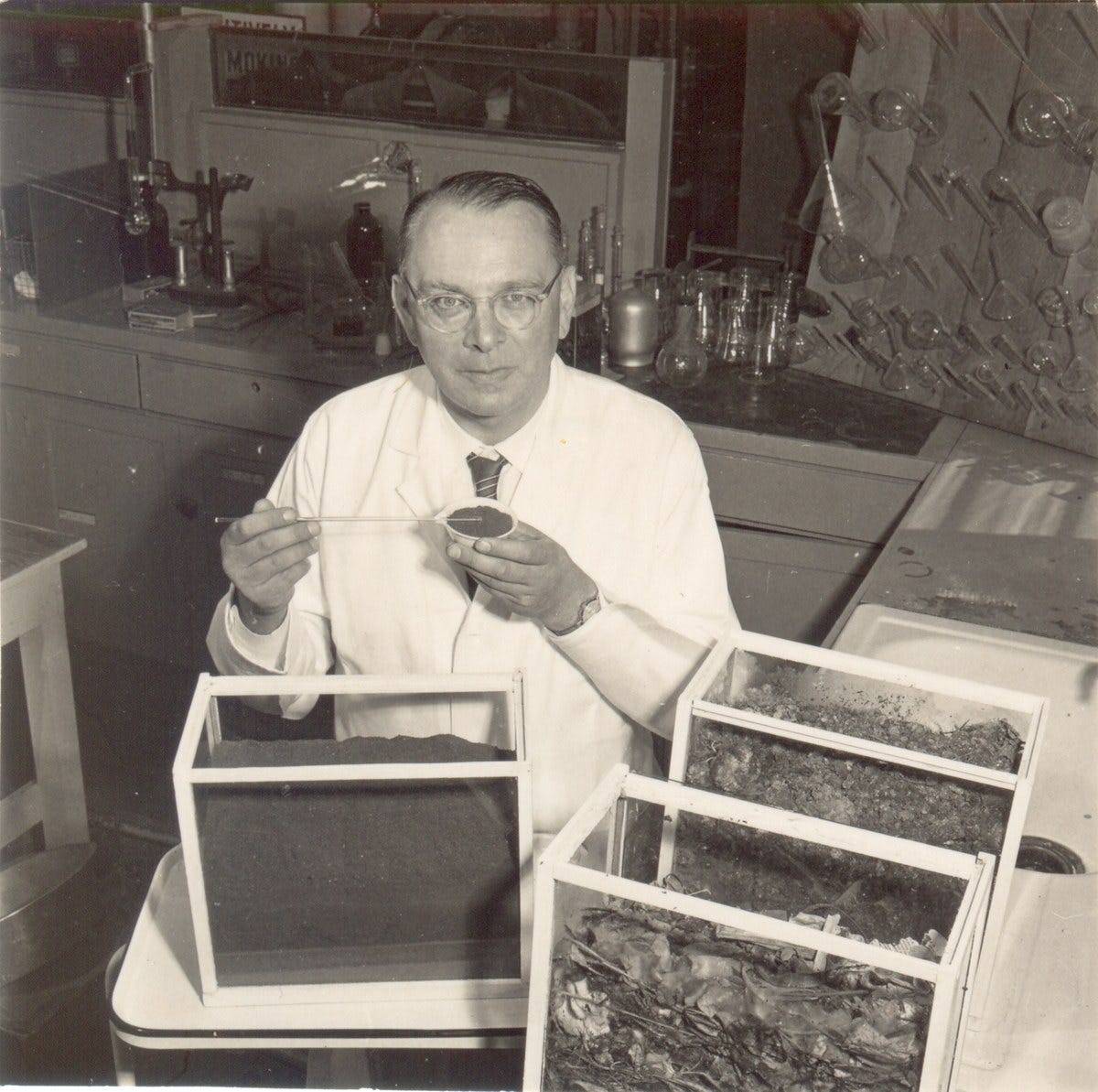
Pfeiffer brought a question of his own to these conversations. The energies the technology of his day ran on were set free by destruction: fuel burned, matter broken down. The science that commanded them worked the same way, by taking things apart, and its machinery had just been through a world war. In living things Pfeiffer saw a force of the opposite kind at work, one that builds up and makes grow, and he wanted to know whether machines could be driven by that force instead. He asked Steiner three questions: “Does such a force or source of energy exist? Can it be demonstrated? Could an altruistic technic be built upon it?” A technic is a technology; an altruistic one would be a technology that could not be turned to selfish ends.
Steiner answered the questions in the order they were asked. “Yes, such a force exists, but is not yet discovered.” On demonstrating it: “As we have reagents in chemistry, so you must find a reagent upon the etheric force.” A reagent is a substance that reveals the presence of something else by reacting to it. The etheric formative forces are, in anthroposophical terminology, the life-forces at work in growing things, the building force Pfeiffer had asked about. And of the machines: “It is possible, then, to develop machines which react upon and are driven by this force.” Detection first, use second, and no way to the second except through the first. The reagent was to be looked for in warmth, in light, and in cultures of bacteria.
A second recommendation went beyond detection, toward the machines themselves. The engines described in the lectures intensify a person’s smallest vibrations, and resonance is how a small movement becomes a large one: a push repeated in time with something already moving builds it up, the way a swing pushed in its own rhythm goes higher than one hard shove could send it. Steiner recommended the study of resonance, and of the body’s own rhythms, the pulse and the breathing, and what they do to sound and to magnetism. The aim was to turn the body’s delicate pulsations into larger waves.
Pulsations that faint could only be detected by a substance that responds to very small influences, and Steiner suggested copper, which conducts electricity better than any metal except silver and can be drawn into very fine strips. A fine copper strip was to be sealed into a Geissler tube, a glass tube emptied of most of its air that glows when a current is passed through it, the ancestor of the neon sign, and the glow watched for changes. A telephone receiver would serve as well, or a wire or thread from a person’s tongue to a flame, with the flame watched for changes. Each arrangement made a movement too small to see show up as something the eye or the ear could follow: as light, as sound, or as motion in a flame.
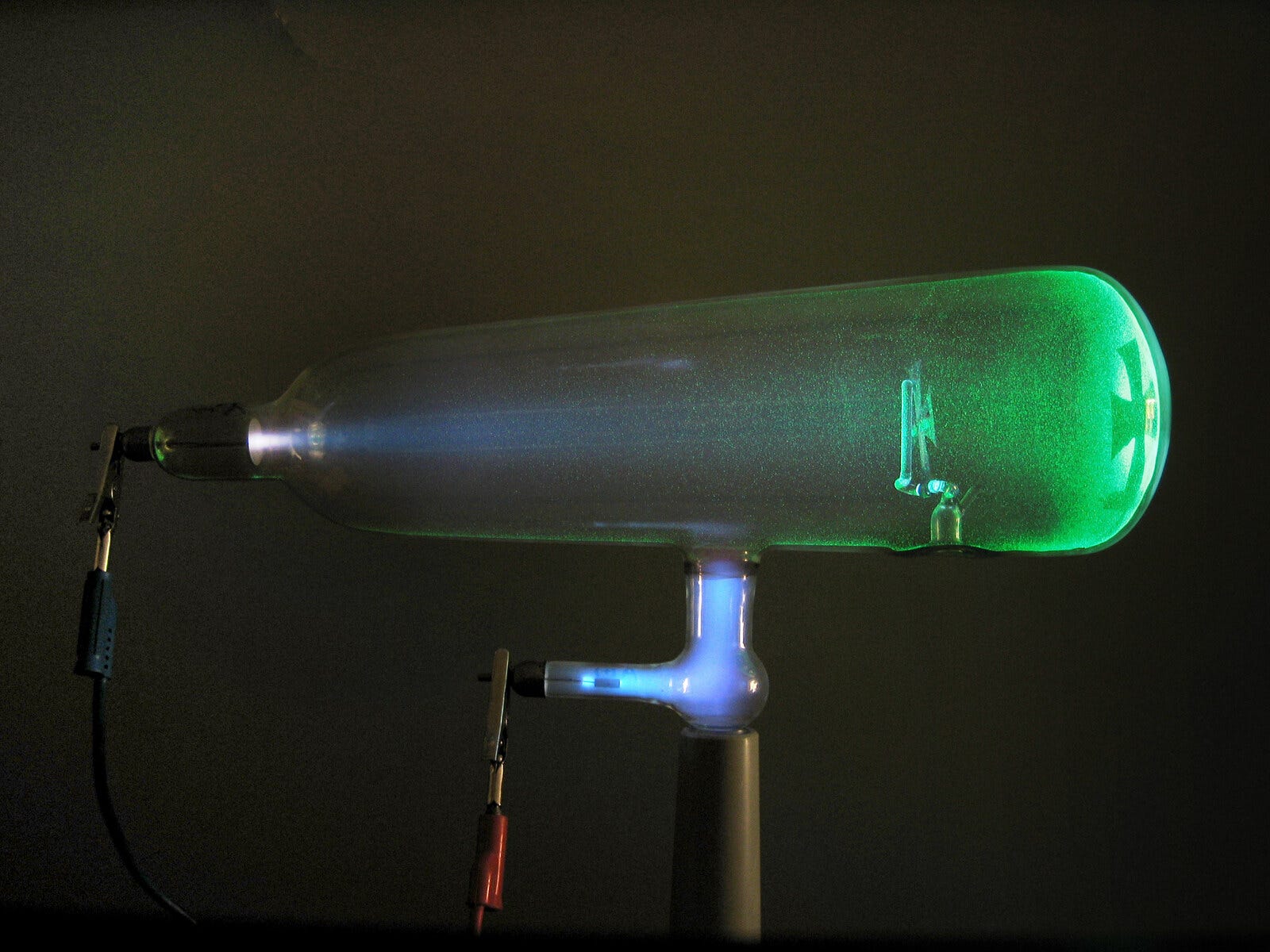
Pfeiffer built the discharge tube and used his own body as the specimen. Brought close to a person without touching, it changed color and its dark regions shifted; an evacuated glass globe held near the body showed light phenomena too. “These light phenomena are quite different for different parts of the body.” The instrument had been set to measure human vibrations, and it did. A change that followed the living body also looked like what a reagent was to do, and Pfeiffer took the result to Steiner. It was the same arrangement as radionics, the dial-covered boxes then being leased to doctors, each wired to a patient and read through the practitioner’s own body, and as the instruments built before them to test the mediums of the séance: a person, an instrument, and an effect that followed the person.
Source: Pfeiffer’s preface to the 1958 edition of Steiner’s agriculture course; his questions and Steiner’s answers in his memoir, A Modern Quest for the Spirit, Mercury Press, 2010, pages 109–110; the research tasks and Pfeiffer’s report of the experiments as recorded in Folios 1 and 4 of The Schiller File, the Natural Science Section’s own compilation, 2007 English edition of Beiträge zur Rudolf Steiner Gesamtausgabe 122, Dornach 2000.
The astral force
Steiner’s answer was that Pfeiffer had detected the wrong thing. The changes “could be traced in the first place to the influence of the astral body, that is to say not to etheric occurrences.” The astral body, in the same terminology, is the member of the human being that carries feeling and desire; the etheric is the member that carries life. Pfeiffer had found something, and it belonged to the wrong part of the human being. The answer followed from something Steiner had told him a few weeks earlier. Asked in April 1921 about the nature of electricity, he had said, “Electricity originated as an astral force.” He added that “One can best observe the being of electricity in the cathode ray tube.” Pfeiffer’s tubes were of the same kind, and the glow he watched was itself an electric current.
Wachsmuth put a question of the same kind, whether the human pulse rhythm could be transposed into greater oscillations, and Steiner’s reply was, “do you now already want to hammer the astral vibrations of man into the cosmos out there?” The file adds that he stressed the words now already.
So the first step, the demonstration that the etheric forces were present, had not been passed. Steiner “ruled out the course of the experiments up to that moment because the time was not yet ripe for the etheric forces to become operative.” Pfeiffer asked when the time would come, and the answer was “when the threefold social order and Waldorf School education were realised and humanity had another moral constitution. Until then, these studies should be carried out in the greatest privacy and secrecy.” The threefold social order was Steiner’s program for separating the cultural, legal, and economic spheres of society so that no one of them rules the others. Steiner’s reason, as Pfeiffer recorded it, was that the time would be ripe “when the social conditions are such that no misuse of this force can be done for selfish purposes.” Until the conditions were met, “experiments in the direction of using the etheric forces would not be successful, or should not be done.”
Steiner also referred to Nature’s Finer Forces, a book by the theosophical writer Rama Prasad, and said that of the seven kinds of ether, information about the first four only might be given, because “the premature knowledge and misuse of the three others could lead to the greatest catastrophes.” Keely comes up in the same conversation. He “could not realise his assertions because his invention would have been exploited for egoistical purposes (war).” What defeated him was not his character but what his machine would have been taken up for. “Only persons with an altruistic morality could and should serve such etheric oscillatory machines, otherwise great destructive mischief occurs.”
There was one requirement more: “All these experiments will only succeed if the laboratory is made into an altar.” Steiner had made the same requirement thirteen years before, in a lecture of January 1908, and there he gave the reason for it. “As long as humanity has not yet been purified, this secret must therefore remain hidden from humanity.”
The instructions went on being given after that. In October 1923 an electrical engineer in the Society asked Steiner what work he could best take up for anthroposophy. Steiner rose, walked to and fro, and said, “prepare a floating freely moving open flame on a fluid and then hold the hands so, like a gothic flying buttress over the flame.” The engineer asked whether it mattered if the person holding their hands there was healthy or sick, and Steiner said that it did. Some weeks later the engineer reported that he could find no regularity in the movements he had verified. Steiner’s answer was “Add some music.”
Source: Pfeiffer’s preface to the 1958 edition of Steiner’s agriculture course (the research program and the university direction in his own words); his answer, its conditions, and the secrecy as recorded in Folio 4 of The Schiller File, the Natural Science Section’s own compilation, from Pfeiffer’s report of the conversations; the reason he set down later, in his memoir, A Modern Quest for the Spirit, Mercury Press, 2010, page 111; the lecture of January 1908 is GA 68d, January 29, 1908.
The condition
Pfeiffer had wanted both a new technology and a new social order out of these forces. Steiner told him he could not have the technology until the social order came first, and that until then it should not be pursued in the open. What stood in the way was not better instruments or more careful experiments. The answer had three parts: the threefold social order, Waldorf education, and another moral constitution in humanity. Together they are one condition at three depths. The first was an arrangement for society as a whole, and Pfeiffer recorded what it would take: “that would only be the case if the Threefold Commonwealth order would be practiced at least over a few territories on earth.”
The second was already under way: the first Waldorf school had opened in Stuttgart in 1919, out of the threefold movement itself. The third was what the other two were to produce, a humanity of another moral constitution.
Source: Ehrenfried Pfeiffer, A Modern Quest for the Spirit, Mercury Press, 2010, page 111. Pfeiffer wrote his memoir in English; the German edition, Ein Leben für den Geist, 1999, is a translation of it.
A social order and a machine look like answers to different questions. But the danger described in the December 1918 lecture on mechanistic occultism is not in the machines. It is in the ends they would serve: nine-tenths of human labor no longer needed, every uprising paralyzed, and, in the counting of secret circles, mastery over the rest of the population of the earth. Nothing in the machines themselves prevents any of that, because a machine has no ends of its own. The ends belong to people, so the protection had to be in the people.
No one becomes unselfish by being told to. People are shaped by the society they live in, and the society of the day was ruled by the contest of economic interests. So the society had to change before the people could. The threefold order was to take away the rule of economic interest, setting economy, law, and culture each in its own sphere, none commanding the others. The schooling was to belong to the cultural sphere, directed by neither state nor economy, so that neither could use the education of the young for its own purposes. People formed in that way were to be the humanity of another moral constitution, among whom, as Steiner had told Pfeiffer, the etheric forces could not be misused for selfish ends.
The timing mattered to Steiner. Pfeiffer records a remark from the same years, about the movement’s practical work as a whole: “Spiritual scientific knowledge must have found its way into practical life by the middle of the century if untold damage to the health of man and nature is to be avoided.”
Source: Pfeiffer’s preface to the 1958 edition of Steiner’s agriculture course.
In a confidential memorandum of August 1971, Hans Kühn, who had heard the lecture of December 1, 1918 himself, vouched for a sentence he reported from it, one that appears in no printed text of the lecture: “Everything depended on the Strader machine being invented in our circles within the next twenty years, because otherwise the Ahrimanic counter-image of it will be developed, which serves only destructive purposes.” Ahriman, in Steiner’s terminology, names the spiritual power at work in mechanization, cold intellect, and the binding of life to matter. Kühn’s generation understood the counter-image to be the atomic bomb.
Source: Kühn memorandum, Arlesheim, August 1971; first published by Podak, Der Europäer, 2003; translated from the German of the printed memorandum.
The first step
The experiments went on after Steiner’s death, inside the movement and unpublished. Paul Eugen Schiller, the physicist who later compiled the Section’s file of these tasks, ran a physics laboratory at the Goetheanum from 1926, in one of the two towers of the boiler house. Writing to Peter von Siemens in November 1955, he described his own experiments with metal spirals, which Steiner had suggested would move at the rising of the sun or the moon, and which were to yield an instrument that recorded changes in the etheric sphere as a barometer records air pressure. Schiller took the experiments to be continuous with the abandoned apparatus: “This task appears to be the preliminary stage of the Strader Motor, resting on the fact that various metals combined in appropriate forms produce an etheric ‘power station.’”
In the same years Schiller gathered every record he could find of the research tasks Steiner had given the movement’s scientists. The collection was circulated privately, on conditions printed in its opening pages. It could be read only on “the supposition that this collection is treated confidentially, and only to be used as working material by the reader himself.” Two further conditions followed: “Passing on such information to other people is only permitted after previous consultation with the management of the Natural Science Section. Care should be taken that in the case of death the compilation should be returned to the Natural Science Section.”
Source: Paul Eugen Schiller, ed., The Schiller File, 2007, the English edition of Beiträge zur Rudolf Steiner Gesamtausgabe 122, Dornach 2000; Schiller’s letter of November 26, 1955, translated there from the German.
Pfeiffer worked the same way. In April 1923 Steiner had told a doctor at St Gallen that some plant substances keep to the rhythm of the year, and lose it when they are heated. Pfeiffer was still working on that remark in 1960. “We don’t teach, we keep silent, I have kept this thought silent for thirty-five years, but we work with it until finally we get an answer from nature.”
Source: Ehrenfried Pfeiffer, lecture at Threefold Farm, Spring Valley, New York, October 23, 1960, printed in Notes and Lectures: Compendium II, Mercury Press.
Steiner had said the studies should be carried on in secret, and they were. The experiments stayed unpublished, the stage models disappeared, and the file of the research circulated privately from the 1950s until 2000.
The theosophists of 1888 had said that a dangerous power should be kept back until the world was fit for it. That was a teaching about what ought to happen. Here a movement did it. The condition it set was its own political program, and that program had already been attempted. Germany had lost the war, the empire had fallen, and for a few months how the country would be governed was an open question. The movement put the threefold order forward as the answer. It published an appeal in March 1919, founded a league for the purpose in April, and organized through that summer among the factory workers of Württemberg, the German state around Stuttgart, where it would open its research institute the following year.
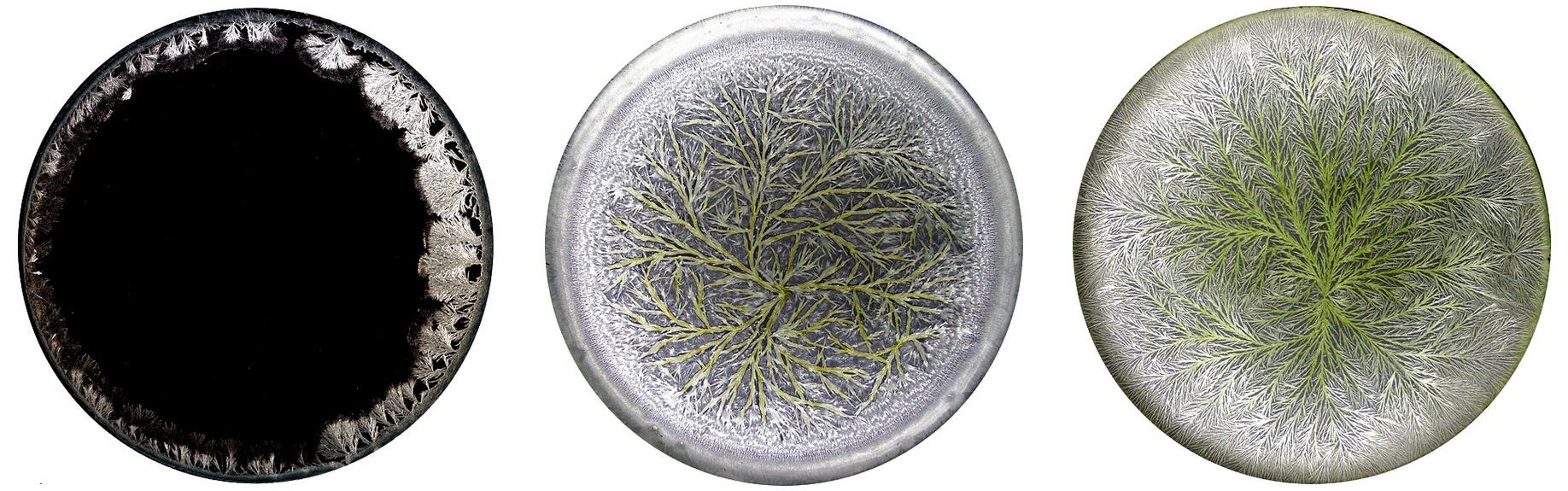
A national law of February 1920 settled the works councils on other lines, and the campaign for the threefold order was beaten within the year. The league broke up soon afterward, and no state anywhere has adopted the threefold order since. Steiner made the open pursuit of the research turn on that, and the laboratory did as he asked. The work, Pfeiffer wrote, “had to remain with the first step, the demonstration of the presence and existence of formative forces.” Pfeiffer had reached that step with his sensitive-crystallization method. The machines that were to be driven by the forces were never built.
Source: Ehrenfried Pfeiffer, A Modern Quest for the Spirit, Mercury Press, 2010, page 111.
Part 8 of “The Occult History of Technology.” Previously: Not Yet Ready.