

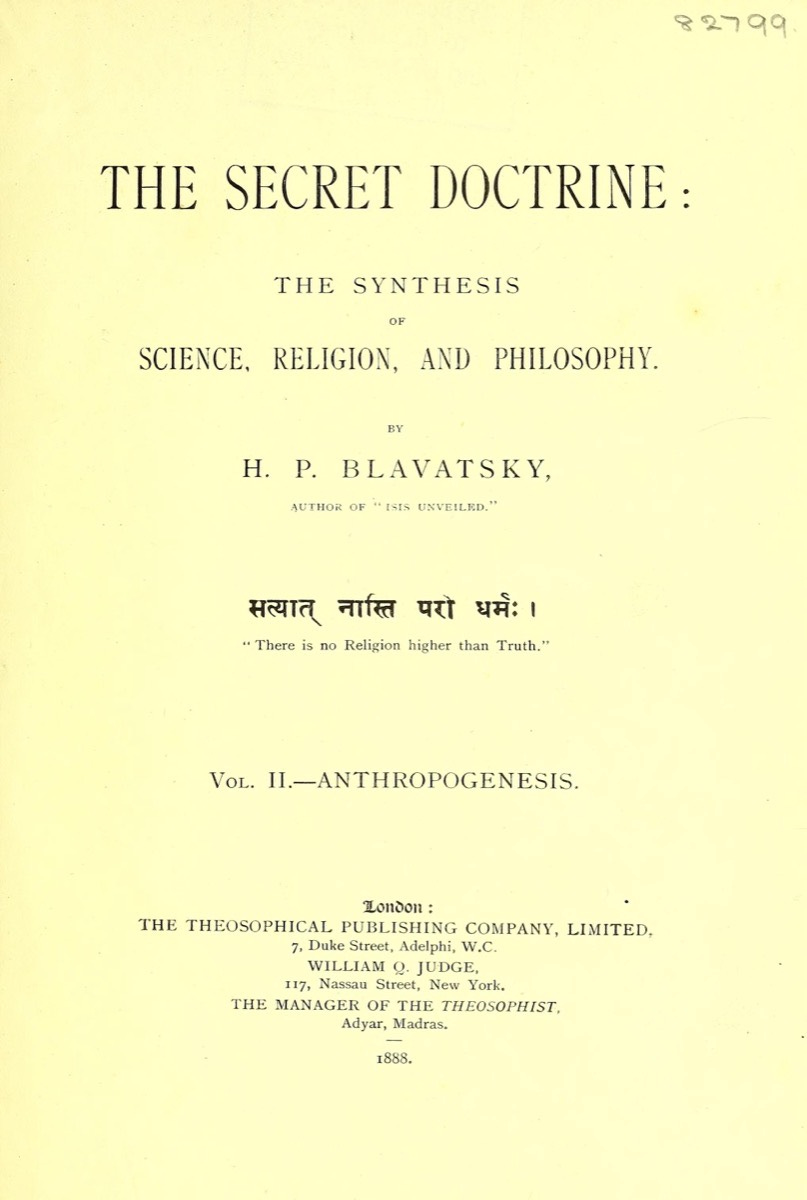
In 1888, ten years before the Philadelphia inventor John Keely died and the investigators took up the floorboards of his workshop, a complete ethics of dangerous technology was set out in London. It is in two documents printed that year, an introduction to a pamphlet about the motor Keely said ran on a force unknown to science, and a chapter of the principal book of Theosophy. The pamphlet says what should happen if the motor worked. The book says why the world had not been given such a power. Between them the two documents contain every element of the present argument about artificial intelligence.
The pamphlet
Theosophical Siftings was a London pamphlet series for members of the Theosophical Society. The Society was founded in 1875, and within a decade it had branches in America, Europe, and India. It was the largest esoteric movement of the age, and educated people took it seriously. Scientists, writers, and social reformers were members. It did much to bring Indian and Buddhist thought before Western readers, and its ideas passed into the art, literature, and politics of the decades that followed. In July 1888 the series reprinted an essay on Keely’s discoveries by his patron Clara Bloomfield-Moore, with an editorial introduction printed before it. The introduction is signed by Richard Harte, secretary of the Theosophical Publishing Society. It is not about whether the motor works. It is about what should happen if it does.
The introduction opens with a story from the mining market. A syndicate of wealthy mining capitalists, it relates, had quietly bought up abandoned gold mines, and the reason was an appointment in a Philadelphia laboratory. Twelve millionaires had watched the inventor touch blocks of quartz with a small machine held in his hand, and each block crumbled to dust with its gold specks exposed. The men then took him to the Catskill mountains and asked him to do it to a quartz reef in place. “In eighteen minutes there was a tunnel in that quartz mountain eighteen feet long and four and a half feet in diameter.” Harte prints the story as fact and adds that the men had bound themselves to secrecy and that this was its first publication. No other record of the demonstration exists. The story asked the pamphlet’s readers to imagine a force in one man’s hands that could open a tunnel through solid rock in minutes, more powerful than any machine of the age, and already drawing the largest money toward it.
Major Ricarde-Seaver, a Fellow of the Royal Society of Edinburgh, had gone to Philadelphia to see for himself. Harte reports what he said on returning, that Keely was “working with, and had the apparent command over forces, the nature, or even the very existence, of which was absolutely unknown to him,” and, so far as he was aware, to modern science.
Then the introduction turns to its real subject, which is not whether the force is dangerous but why. On Harte’s account the danger is not in the power but in the people who would have it. The occult teaching, he writes, is one of readiness: “Occultists, as a rule, believe that the world is not yet ready for the appearance of such tremendous forces on the stage of human life.” The world is not ready because the people are not. “Mankind is too selfish, too cruel, too stupid, too pitiless, too animal, to be entrusted with what, in sober reality, are minor ‘divine powers’.” He put it in one sentence: “It would be less disastrous to give dynamite cartridges to monkeys for playthings.”
The power is real. The danger is not in the power, and not in any misuse that better rules could prevent. It is the moral condition of the species that would have it. The argument does not depend on Keely. Any force great enough would raise the same question.
Harte names a second danger, and it is not misuse. It is that the power would come to be owned by a few. He argues from what had already happened with industrial machinery. “The advantages that accrue from steam and from machinery have not been distributed, but have become the property of a small minority.” Competition grew fiercer year by year, and “men are growing more and more like living machines, and the helpless slaves of machinery and of ‘institutions.’” If Keely’s inventions were handed over finished, he reasons, they would fall to the same minority, and “the capitalists who owned the tremendous powers implied in a monopoly of Keely’s inventions would be practically the absolute masters of the people.”
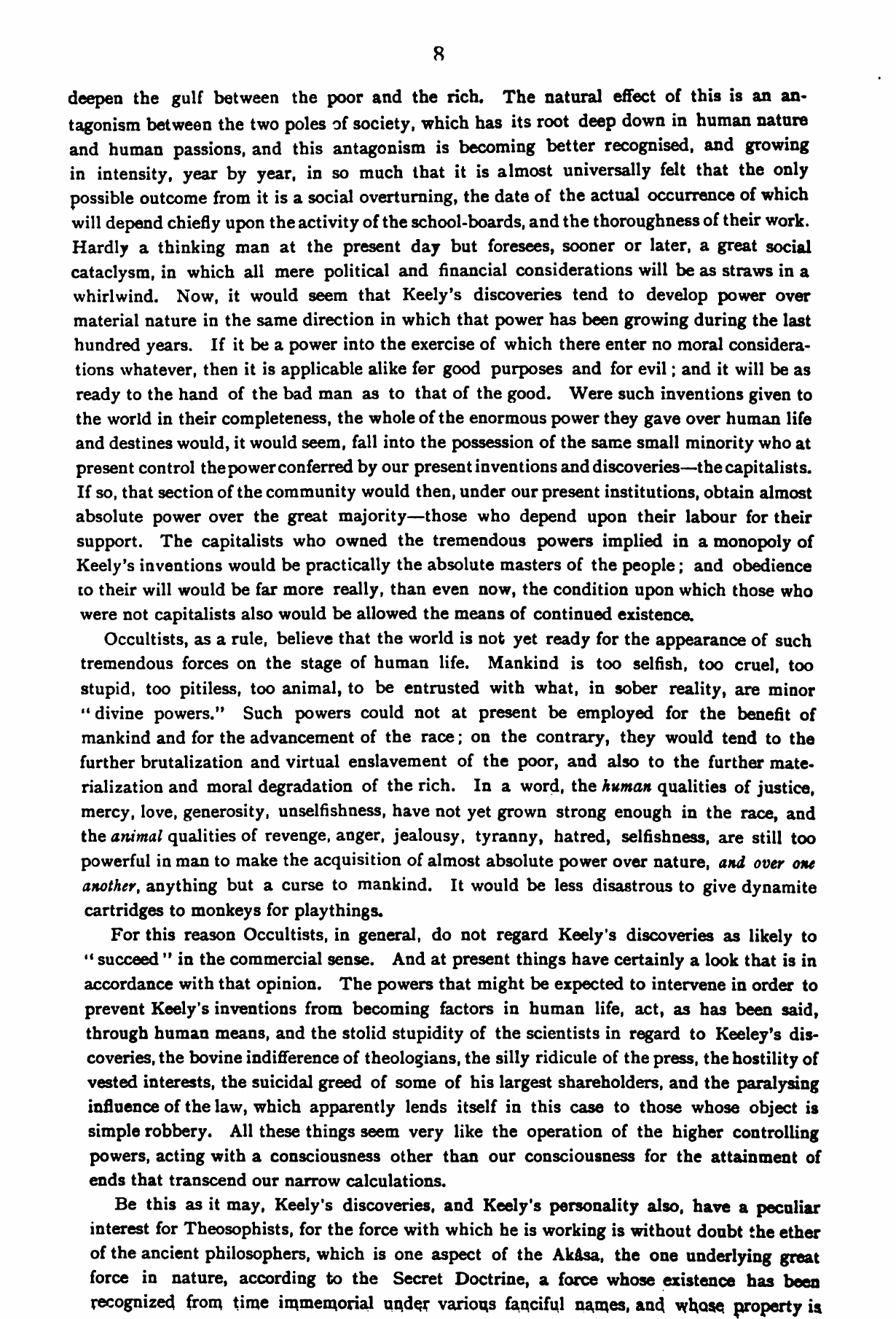
The introduction also says how the withholding works. The occultists’ belief, Harte writes, is that “these forces cannot be introduced into the practical life of men, or fully understood by the uninitiated, until the world is fit to receive them with benefit to itself.” There are, on this teaching, intelligent powers behind the visible events of life, “which powers alone can say ‘So far shalt thou go, and no farther’”; and these powers act through ordinary causes, not around them. Harte lists the ordinary causes in Keely’s case: the indifference of the scientists, the ridicule of the press, the hostility of vested interests, the greed of his own shareholders, the pressure of the law. “All these things seem very like the operation of the higher controlling powers, acting with a consciousness other than our consciousness for the attainment of ends that transcend our narrow calculations.” On this account, the daily frustration of the work, the very record of lawsuits and mockery told elsewhere as a story of fraud exposed, is itself the containment operating.
Source: the introduction to “Keely’s Secrets,” Theosophical Siftings vol. I, no. 8, 1888; signed by Richard Harte.
The failure that protects
Harte’s introduction stated the ethics. The Secret Doctrine, the two-volume book of H. P. Blavatsky, the movement’s founder, published the same year, stated a mechanism: not what ought to be done with the force, but what the force itself does.
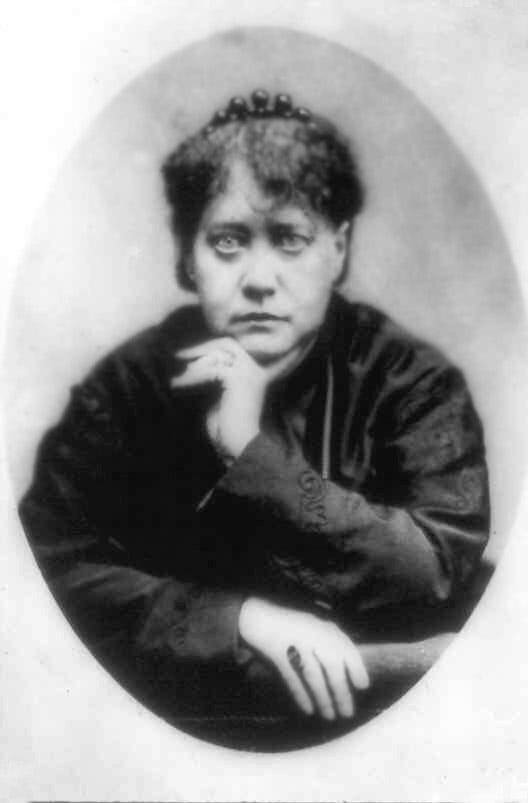
Blavatsky does not argue that Keely’s force should be withheld. She asserts that it is already being withheld, not by any human decision but by the nature of things, through the very failure his investors were paying him to overcome.
The chapter called “The Coming Force” says that Keely’s discoveries “will prove wonderful — yet only in his hands and through himself. The world so far will get but that with which it can be safely entrusted.” That dependence is itself the containment, because a force that works only through one prepared person cannot be mass-produced, cannot be sold, and cannot be handed to the capitalists or the armies. The book states the disproportion in a military image: “Had Keely been permitted to succeed, he might have reduced a whole army to atoms in the space of a few seconds as easily as he reduced a dead ox to the same condition.” And Blavatsky set the unreadiness on a scale far beyond any human plan. The discovery, she wrote, “in its completeness is by several thousand — or shall we say hundred thousand? — years too premature.”
The book also explains why the force could not pass to anyone else. Blavatsky had been told, years before, that the inventor “was what is called, in the jargon of the Kabalists, a ‘natural-born magician’”. The Kabalists were students of Kabbalah, the Jewish mystical tradition; a natural-born magician, in that usage, was a man born with a capacity he did not understand and could not teach, one inherent in his special nature and impossible to pass to anyone else or make permanent for use. This is the magician’s rule of 1533 applied to a machine shop: the power belongs to the man, not to the machine. Keely’s whole difficulty, on Blavatsky’s account, had been to build a machine that would run the force without his own will behind it, conscious or unconscious; in that he had failed, for no one but himself could work his machines. Of the force itself she keeps the distinction personal: “It was ‘Keely’s ether’ that acted truly, while ‘Smith’s or Brown’s’ ether would have remained for ever barren of results.”
As evidence that the man and not the machine produced the results, the chapter prints a story from inside the company. The shareholders of the Keely Motor Company had placed a man in the workshop to discover the secret. After six months of watching, while the two were setting up a machine together and Keely worked the stop-cock that turned the force on and off, the watcher told him: “I know how it is done, now.” “Try it, then,” was the answer. The man turned the cock, and nothing came. He asked to see it done again. Keely complied, and the machinery ran. The man tried again and failed again. Then Keely laid a hand on the man’s shoulder and told him to try once more. With Keely’s hand on him, the man turned the cock and the machinery operated at once. The chapter closes the story with its own condition attached: “This fact, if true, settles the question.”
The doctrine behind the story was already in print, ten years before Keely died. The force follows the person, and without that person the machine does nothing.
The same chapter makes Keely’s failure not an accident but a certainty: “It is just because Keely’s discovery would lead to a knowledge of one of the most occult secrets, a secret which can never be allowed to fall into the hands of the masses, that his failure to push his discoveries to their logical end seems certain to Occultists.” The failure is offered as one instance of a custody rule: “For once out of the safe custody of their legitimate heirs and keepers, those mysteries cease to be occult: they fall into the public domain and have to run the risk of becoming in the hands of the selfish — of the Cains of the human race — curses more often than blessings.” The same pages extend the rule to trade. The results obtained from the higher planes of the force, the book says, “will never be permitted to serve for purposes of commerce and traffic.”
Source: H. P. Blavatsky, The Secret Doctrine, vol. I, “The Coming Force,” 1888.
On this doctrine the failure is not an engineering shortfall but a permission withheld. The world’s unreadiness acts as a physical constraint. Reduced to its logic, the claim is that dangerous capability limits itself through the moral state of whoever has it. No modern safety regime assumes such a law. Blavatsky asserted one, and pointed to twenty-six years of demonstrations that never once transferred as her evidence.
The cost
The doctrine had a cost, and the pamphlet names who paid it: Clara Bloomfield-Moore, Keely’s patron, who paid him a monthly allowance for seventeen years, and much beyond it, for the failure the doctrine calls protection. The pamphlet notes that the Keely Motor Company itself had for years contributed nothing to Keely’s expenses or support. The burden was hers. And in the Philadelphia Inquirer article Harte quotes, printed that January, Bloomfield-Moore herself had written that had “scientists, instead of speculators, furnished him with the means necessary to carry on his ‘work of Evolution,’ the secrets which he has so carefully guarded would now have been public property, so little does he care personally for financial results.” She brought in the examiners of 1895 herself, and she died seven weeks after Keely, before the floorboards came up. Investors bought a motor, and the doctrine explains why they could not have one.
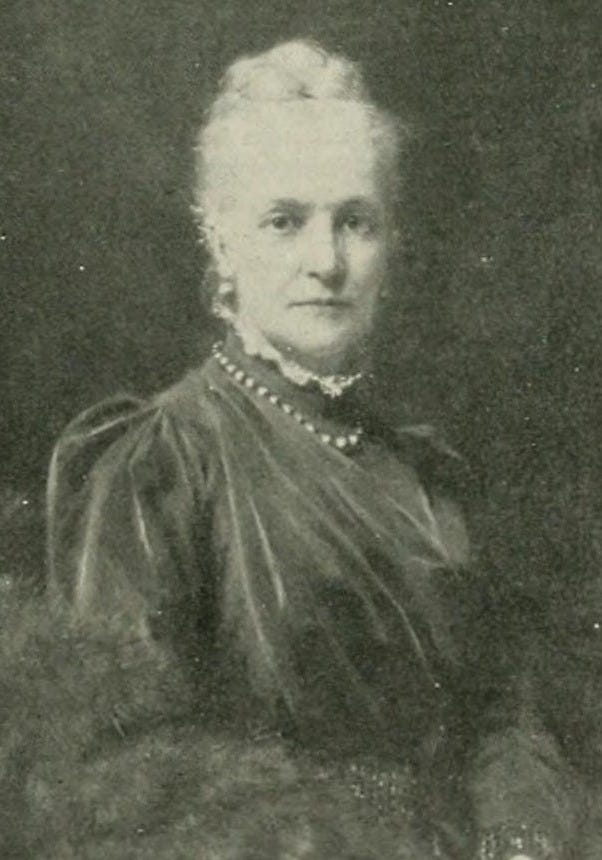
Georg Unger, who worked within anthroposophy, the movement Rudolf Steiner founded, surveyed this literature in 1963. He placed the account in what he called the “‘conservative’ or ‘right wing’ section of the occult movement,” borrowing a distinction Steiner had drawn between occultists who held that nothing of the old knowledge should reach the public and those who thought some part of it had to be published. Keely’s results, he wrote, “were not permitted to lead to a premature disclosure of certain capacities.”
Source: Georg Unger, On Mechanical Occultism, a 1963 Wiesbaden lecture, in The Golden Blade, 1966, pages 42 to 56, at page 52; the underlying distinction in Rudolf Steiner, lecture of October 10, 1915 (English translation, made from the German printing in Mitteilungen aus der Anthroposophischen Arbeit in Deutschland, 1964); the rescue sentence from Harte’s 1888 introduction.
Two readings of the same story stand, and the documents support both. The doctrine calls Keely’s lifelong failure a protection. The ordinary account calls it twenty-six years of investors’ money and no engine. Choosing between them means deciding whether the doctrine is true, which is not a question the documents answer.
By 1888 the whole argument was complete and in print, attached to a working inventor while his company’s stock was still selling. The force is real, and science does not know it. It is being kept from the world. A power can be too dangerous for the people who would have it. The danger lies in those people and not in the power. Whoever owns such a power owns everyone else. The right course is to withhold it until the world is fit for it. Those claims are being made again now about artificial intelligence.
The force ran through Keely and through no one else. There was nothing to manufacture, nothing to sell, and nothing to hand to a government or a firm. Nobody had to decide to withhold it, because nothing could be transferred in the first place. What the doctrine described as a protection was a fact about the machine.
A trained artificial intelligence model is a file of numerical parameters, produced once and copied exactly. It runs on hardware that can be bought or rented, and it does not need the person who made it. Some of these files are published for anyone to download.
Any limit on such a model has to be somebody’s decision. The 1888 argument concerned a power that could not be distributed. The present one concerns a power that already has been.
---
Part 7 of “The Occult History of Technology.” Previously: The Operator in the Circuit.