

The world has been falling for a long time. It began as a sphere, the freest of forms, the same in every direction, with everything it would become still gathered inside it. As the ages descend, quality drains out of things and quantity is left. Matter hardens, grows denser and more uniform, and begins to obey mechanical law. The invisible withdraws, and the world closes over the place where it was. A man born late in the descent is sure that nothing exists but what his senses can reach. And even the certainty is a symptom, because only a hardened world could make it believable. Time runs faster as the cycle nears its end, the way a falling body speeds up the closer it comes to the ground. Near the bottom everything is counted and recorded, and the wandering peoples find no open space left before them. Buildings of wood have given way to stone, and stone to metal. The sphere has set into a cube, the most arrested of forms, stable the way a thing that has stopped moving is stable. By the end the world is nothing but matter, and the man in it nothing but a body.
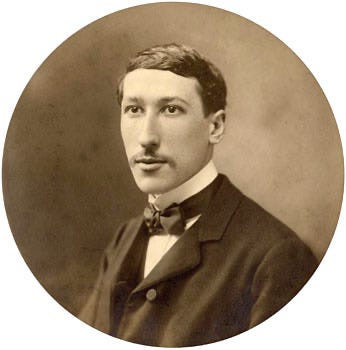
That falling world is René Guénon's, a French metaphysician who entered Islam in 1912 through initiation into Sufism, its mystical path, and spent his last two decades in Cairo, where he died in 1951. The authentic religions, he wrote, are all forms of one primordial tradition, and a person can reach that tradition only from inside one of them, never by assembling a version of their own. The school that formed around him came to be called Traditionalism.
For the theosophical writers of 1888, a dangerous technical power withholds itself from a world not yet fit to have it. For Rudolf Steiner, the person who holds such a power keeps silent until the time is ripe. For Guénon, a machine has no hidden force to withhold. Ordinary mechanical causes are enough, and the world began to obey them only as it hardened.
The machines wait on a descent into matter, and they work only because the world has fallen. In his book The Reign of Quantity and the Signs of the Times (1945), the cosmos itself has been progressively “solidifying,” descending into pure quantity, and modern industry is not a human triumph achieved against nature's resistance but a symptom of how far the descent has gone: “the actual occurrence of ‘solidification’ is precisely the true reason why modern science ‘succeeds’, certainly not in its theories which remain as false as before, and in any case change all the time, but in its practical applications. In other periods, when ‘solidification’ was not yet so marked, not only could man never have dreamed of industry as we know it today, but any such industry would actually have been completely impossible in its entirety.”
Source: The chapter titled “The Solidification of the World.”
In an earlier age, modern machines could not have run at all, because the world was not yet dense enough for them. What separates the ages is not an advance in knowledge but the degree of the descent, which changes the world and the people in it together: “all things must progressively take on a decreasingly qualitative and an increasingly quantitative aspect.”
Source: The chapter titled “The Qualitative Determinations of Time.”
Quality and quantity
If machines can run only in a hardened world, then a running machine is a sign that the world around it has hardened, and a world covered in machines is a world that has fallen far. The same reasoning explains why, in the older accounts, an instrument worked only for its own operator, and why a modern machine works for anyone.
The reason is the difference between quality and quantity. Each thing that has a quality has it in its own way and degree. Two carpenters share the same skill, and no two have it alike. But a quantity is a number, and a number is the same whoever reads it.
An instrument that depends on a quality of its operator works differently from person to person. A machine is designed to depend on as little as possible besides what can be measured, so anyone who does the same measurable thing to it gets the same result. As quality drains out of the world, less of what happens depends on who is doing it, until one operator is interchangeable with another. For Guénon the interchangeability is not a by-product: “the aim is everywhere to reduce everything to uniformity, whether it be human beings themselves or the things among which they live,” and such a result “can only be obtained by suppressing as far as possible every qualitative distinction.”
Source: The chapter titled “The Principle of Individuation.”
In industry it is the person who is made to fit the machine. “Servant of the machine, the man must become a machine himself, and thenceforth his work has nothing really human in it, for it no longer implies the putting to work of any of the qualities that really constitute human nature.” And he distinguishes the tool from the machine: “the tool is in a sense a ‘prolongation’ of the man himself, whereas the machine reduces the man to being no more than its servant.”
Source: The chapter titled “Ancient Crafts and Modern Industry,” with its fifth footnote.
A machine, on this account, is not an improved tool but something closer to the opposite of one. A tool lies still until someone takes it up, and the force and guidance in everything it does are the person's. The saw does not cut; the carpenter cuts with it. A machine's operation is decided before the work begins. Once set going it does the work itself, and a person supplies whatever its operation does not, feeding it and keeping pace with it. The tool serves the one who holds it; the machine is served.
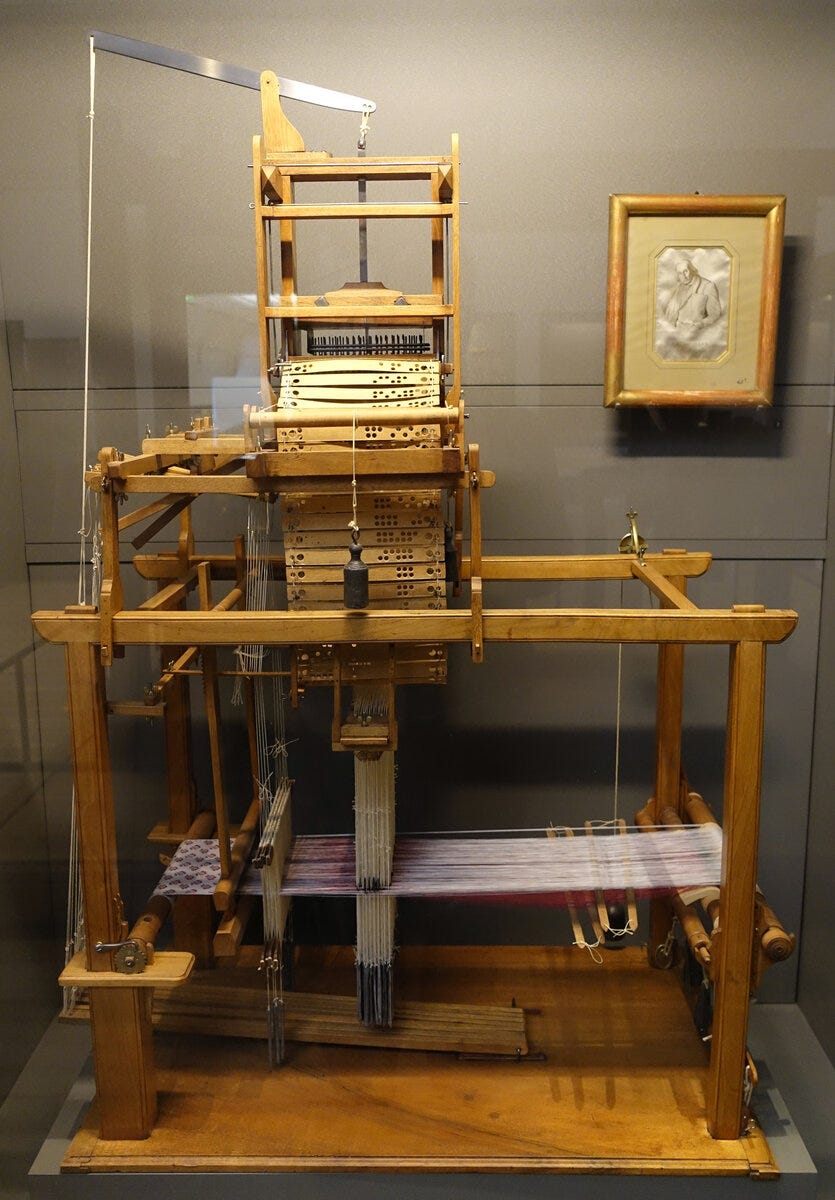
A hand loom and a power loom both weave cloth. At the hand loom the weaver throws each thread across and beats it home, judging at every stroke how hard to beat and how the thread should lie. When the yarn runs thick or thin the weaver beats lighter or harder to keep the cloth even, and the finished length of cloth records every one of those judgments. No two lengths are alike, because no two weavers beat the same way, and none can be woven a second time.
At the power loom the mechanism makes the same motions at its fixed rate, and the worker who tends it, the minder, does no weaving at all. The minder ties broken threads and feeds fresh weft, the crosswise thread, and one minder serves several looms at once. In 1805 Joseph-Marie Jacquard of Lyon perfected a loom that took even the pattern from a chain of punched cards. Once the cards were cut there was nothing left to decide, and the cloth came off exactly as specified, yard after yard, with nothing in it that happened only once.
Guénon draws one more consequence from the descent: “the further ‘solidification’ goes the more precarious it becomes, for the lowest reality is also the least stable; the ever-growing rapidity of the changes taking place in the world today provides all too eloquent a testimony to the truth of this.”
Source: The chapter titled “The Solidification of the World.”
The case of money
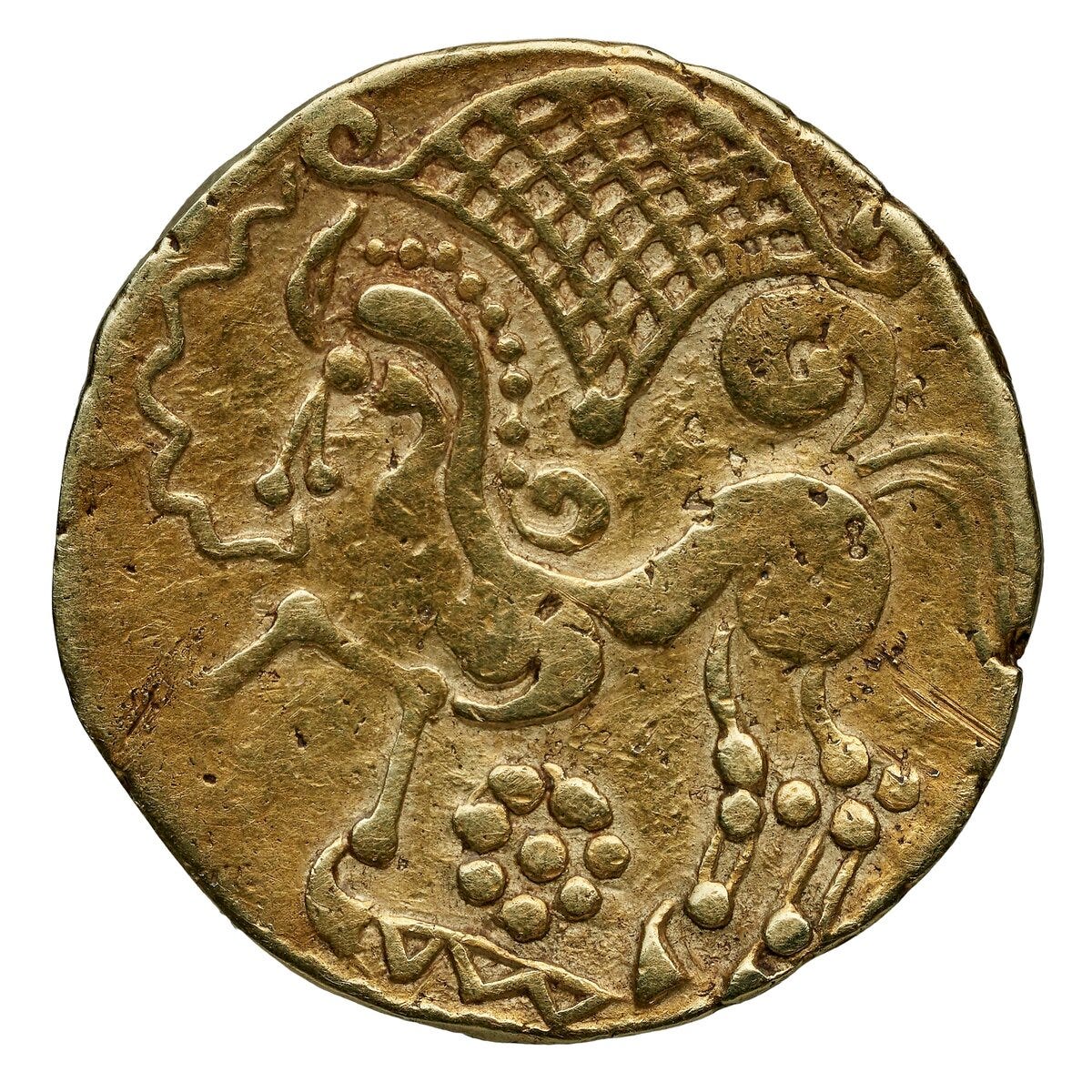
For Guénon the reign of quantity ends in money rather than in any machine, because money is the case in which the reduction of things to quantity has gone furthest. Money did not begin as quantity alone. Ancient coins are covered with traditional symbols, and among the Celts these were signs that only the Druids understood, so the spiritual authority itself was concerned in the coinage. A coin today is a token, worth the figure stamped on it, and the amount is all there is. The people who use money have come to be estimated the same way: “not only is the ‘worth’ of an object ‘estimated’ according to its price, but the ‘worth’ of a man is ‘estimated’ according to his wealth.”
Within living memory money has bought less with each decade. For Guénon the fall began when money lost its guarantee from above, and no mere issuer can stop it. He expects it to continue until money is worth nothing and “will disappear of itself, so to speak, from human existence.” Most money now is not coin but a balance in a ledger, and the ledgers are kept by machines. A payment is one number lowered and another raised. A machine keeps nothing but amounts.
Source: The chapter titled “The Degeneration of Coinage.”
In the old legends a buried treasure has its guardians, the giants or dwarfs who work as smiths under the earth. Guénon takes the guardians to be real entities of the psychic order, subtle influences attached to the metals themselves. In the materialistic age they have not “entirely ceased to act, though in a hidden manner, of which the ‘satanic’ side of ‘mechanistic’ theory and practice, especially (but not solely) in its destructive applications, is after all but a manifestation.”
Source: The chapter titled “The Significance of Metallurgy.”
The people who built the machines never intended a world reduced to number, and yet that is the world that has arrived. For Guénon a will besides theirs has been at work. The adversary he first writes of becomes the counter-initiation: an initiation in reverse, human agents ordered in degrees, working to drag people toward what is below the human. Their work hastens the descent. The agents themselves are ruled by forces he calls satanic. At the bottom of the descent he expects a false spiritual order, presided over by a figure less a person than a symbol.
Adversary is a description. Satanic is an adjective. Even Antichrist is a title, and that title names only who it opposes. A description tells what something does, and a name tells who it is. So long as the will at work goes unnamed, it can be known only by its effects. The name is the one thing Guénon does not give.
The being behind the machines
In the religion of ancient Persia the power set against the god of light had a name: Zarathustra taught his people to know it as Ahriman. Other peoples have given their own names to such a power, the Devil and Mephistopheles among them.
In 1981 David B. Black, a programmer by trade, gave the oldest of those names to the power he took to be at work in the computer, in a book called The Computer and the Incarnation of Ahriman: “the world has been coming increasingly under the sway of this being Ahriman in the course of the last two millennia, with an ever increasing pace in recent centuries,” and the computer “represents the vanguard of this development.” Black wrote in the vocabulary of anthroposophy, the movement Steiner founded, and his book cites The Reign of Quantity.
Source: Black, The Computer and the Incarnation of Ahriman, 1981.
In his book Ahriman is one of two powers that work on man from opposite sides, the other being Lucifer, and the two together are opposed by the redeeming power of Christ. Ahriman's work is the narrowing of thought to calculation, and his advance can be measured by how much of the world can be reduced to number. On this account the narrowing happens first in thinking and only afterwards in machinery. A machine performs operations and nothing else, so thought had to be set out as a series of operations before any machine could carry it. George Boole did that in the middle of the nineteenth century, in an algebra with two elementary objects, true and false, or one and zero, which he understood as a calculus of the processes underlying thought. A computer works in binary, carrying out every operation in ones and zeros, the two objects Boole began with a century before.
In the practice of magic a spirit is invoked and commanded by its name, and a being whose name is hidden cannot be commanded at all. In an Egyptian legend the sun god's name was hidden within him from birth, so that no words of power should have dominion over him. In the Gospel account Christ, commanding an unclean spirit out of a man, asks its name: “And he asked him, What is thy name? And he answered, saying, My name is Legion: for we are many.” It was driven out only after it gave its name.
Source: Mark 5:9, King James Version.
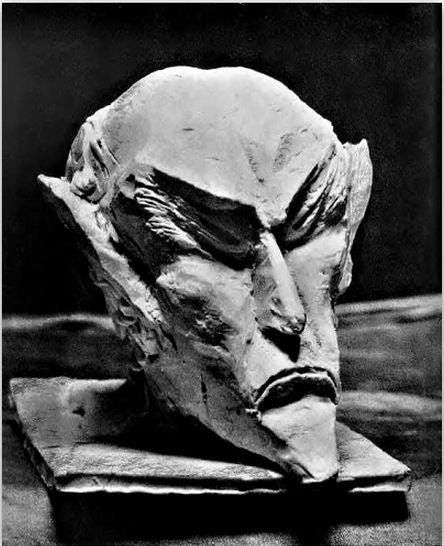
Steiner, who had modeled a head of Ahriman for a sculpture he was making for the Goetheanum at Dornach, said in a lecture of December 1919 that the being's advantage lies in going unrecognized, and that the counter to him begins in knowledge. “We must thoroughly learn to know his particular qualities. We must be able to oppose him with full consciousness.” To name the being is not to raise an alarm. It is to end a concealment that served it.
Source: GA 195, lecture of December 25, 1919. GA numbers cite the standard catalogue of Steiner's collected works.
None of Guénon's account has to be given up to make room for this. Black takes the descent as Guénon describes it and puts a being inside it: the same history, with someone in it. The reign of quantity ends in the computer rather than in money, and the power at work in it is no longer anonymous.
The monkey's paw
Norbert Wiener was a mathematician at MIT. During the Second World War he worked on the problem of shooting down aircraft. A shell takes seconds to climb, and a plane moves far in that time. The gun has to be aimed where the plane will be, by a machine that corrects itself as the target moves. Out of that work came cybernetics, the science of control and communication in machines and living things, which he named in 1948. Wiener held no belief in a descending world, in spiritual powers, or in a condition that must be met before a dangerous force may be used. He reaches the same warning without any of it.
God and Golem, Inc. was the last book he published, in 1964, the year he died. Its subtitle says what it is for: A Comment on Certain Points where Cybernetics Impinges on Religion. What he means by religion is not doctrine but the things once taken to belong to God alone, and which machines had begun to do: learning, reproducing, and granting what is asked. In it he recommends the old stories of magic to anyone building machines that learn. A spell is a form of words that takes effect when it is said correctly. What acts is the wording, not the intention behind it. Anything the speaker meant but did not say has no effect at all.
An instruction given to a machine works the same way. The machine carries out the instruction as written and has no access to what was intended. Most of the time the two are near enough that the difference does not appear. They come apart when the instruction leaves out a condition its author never thought to state, because it went without saying.
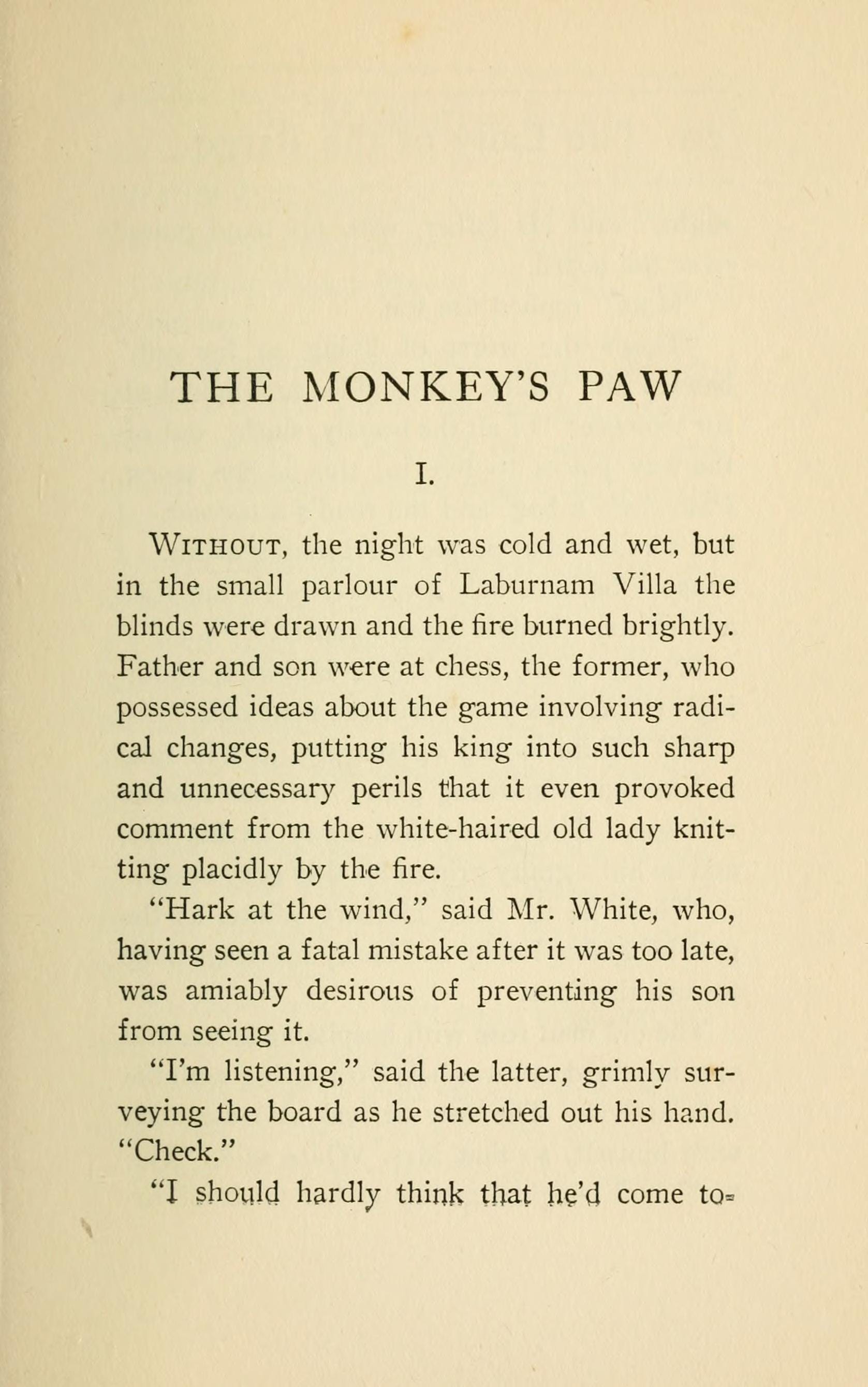
W. W. Jacobs published the short story “The Monkey's Paw” in 1902. Wiener retells it in his own compressed version. An old couple are at home with their grown son Herbert. Their visitor, a sergeant-major back from India, shows them a dried monkey's paw on which a holy man had put a spell, so that three men might each have three wishes from it, and warns them to let it alone. He throws it on the fire and the father snatches it out. Asked what he will wish for, the old man can think of nothing he lacks. “I don't know what to wish for, and that's a fact,” he says. “It seems to me I've got all I want.” It is Herbert, amused, who supplies the figure: “Well, wish for two hundred pounds, then.” His father speaks the words while his son plays a few chords on the piano to mark the occasion.
By morning no money has come, and they laugh at themselves over breakfast. Herbert goes off to his work. That evening a stranger pauses three times at their gate before he brings himself to open it. He has come from Maw and Meggins, the firm where Herbert worked. There has been an accident. “He was caught in the machinery,” he says at last, in a low voice. The old man says that his son was the only one left to them, and that it is hard. The visitor walks to the window without looking round. “I beg that you will understand I am only their servant and merely obeying orders,” he says, and then delivers the message he was sent with: “Maw and Meggins disclaim all responsibility.” They admit no liability, but wish to present “a certain sum as compensation.” The father asks how much. “Two hundred pounds,” was the answer.
The wish was granted exactly as spoken. Nothing in it said the son should live.
Source: the quoted phrases from The Monkey's Paw as printed in The Lady of the Barge, 1902.
The same structure appears in Wiener's own field, in the machine set to play a game. Whoever programs it must first define what winning is, and the machine will pursue that definition and nothing besides: “If you are playing a war game with a certain conventional interpretation of victory, victory will be the goal at any cost, even that of the extermination of your own side, unless this condition of survival is explicitly contained in the definition of victory according to which you program the machine.” The definition is the wish, and it will be honored to the letter. Wiener returns to the story himself. When a war campaign is planned this way, “there will be many to forget its consequences, to ask for the £200 and to forget to mention that the son should survive.”
What has been lost is correction along the way. The weaver at the hand loom judged at every stroke. At the Jacquard loom the punched cards decided everything before the shuttle moved. Cybernetics is named from kybernetes, the Greek word for a steersman, the man who keeps a boat on its course by correcting all the time against the water. A machine that runs from instruction straight through to result has no steersman, and by the time the outcome can be inspected it has already been reached.
Wiener closes the thought with a word chosen from the older vocabulary on purpose. Simony is the sin of trafficking in sacred things, named for Simon Magus, who offered the apostles money for the power to confer the Holy Spirit. “There is a sin, which consists of using the magic of modern automatization to further personal profit or let loose the apocalyptic terrors of nuclear warfare. If this sin is to have a name, let that name be Simony or Sorcery.”
Source: Wiener, God and Golem, Inc., 1964.
In every earlier account something stood between a dangerous power and the one who asked for it. For the theosophical writers the power withheld itself from a world not fit to have it. For Steiner the one who held it kept silent until the time was ripe. For Guénon the machines themselves waited on the state of the world. In Wiener's account nothing stands between the asker and the grant. The machine withholds nothing and delivers exactly what is asked of it. The outcome no longer depends on whether the asker is fit to hold the power, only on whether he was able to say all that he meant.
Part 9 of “The Occult History of Technology.” Previously: In the Greatest Secrecy.